
|
You entered: sky
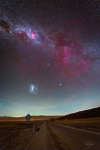 The Gum Nebula Supernova Remnant
29.11.2022
Because the Gum Nebula is the closest supernova remnant, it is actually hard to see. Spanning 40 degrees across the sky, the nebula appears so large and faint that it is easily lost in the din of a bright and complex background.
 APOD: 2023 May 10 Б Milky Way over Egyptian Desert
10.05.2023
For ten years the stargazer dreamed of taking a picture like this. The dreamer knew that the White Desert National Park in Egypt's Western Desert is a picturesque place hosting numerous chalk formations sculpted into surreal structures by a sandy wind.
 APOD: 2023 August 6 Б SN 1006: A Supernova Ribbon from Hubble
6.08.2023
What created this unusual space ribbon? The answer: one of the most violent explosions ever witnessed by ancient humans. Back in the year 1006 AD, light reached Earth from a stellar explosion...
 The Crew 7 Nebula
31.08.2023
Not the James Webb Space Telescope's latest view of a distant galactic nebula, this illuminated cloud of gas and dust dazzled early morning spacecoast skygazers on August 26. The snapshot was taken about...
 APOD: 2024 September 8 Б M31: The Andromeda Galaxy
8.09.2024
The most distant object easily visible to the unaided eye is M31, the great Andromeda Galaxy. Even at some two and a half million light-years distant, this immense spiral galaxy -- spanning over 200,000 light years -- is visible, although as a faint, nebulous cloud in the constellation Andromeda.
 APOD: 2024 December 3 Б Ice Clouds over a Red Planet
3.12.2024
If you could stand on Mars -- what might you see? You might look out over a vast orange landscape covered with rocks under a dusty orange sky, with a blue-tinted Sun setting over the horizon, and odd-shaped water clouds hovering high overhead.
 Curly Spiral Galaxy M63
22.05.2025
A bright spiral galaxy of the northern sky, Messier 63 is nearby, about 30 million light-years distant toward the loyal constellation Canes Venatici. Also cataloged as NGC 5055, the majestic island universe is nearly 100,000 light-years across, about the size of our own Milky Way.
 Jupiter and the Meteors from Gemini
18.12.2025
Jupiter, the Solar System's ruling gas giant, is the brightest celestial beacon at the center of this composite night skyscape. The scene was constructed by selecting the 40 exposures containing meteors from about...
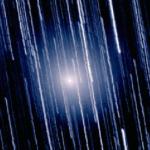 Tempel-Tuttle: The Leonid Comet
30.01.1998
Star trails streak this composite time exposure of Comet Tempel-Tuttle recorded by T. Puckett on January 26. Presently passing through the inner solar system on its 33 year orbit around the Sun, Tempel-Tuttle has brightened unexpectedly, but binoculars or small telescopes are still required to visually observe it.
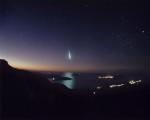 Mediterranean Leonid 2001
7.12.2001
A road trip from Ankara to the Mediterranean coast southeast of Antalya, Turkey found clear skies and splendid scenery for astrophotographer Tunc Tezel's viewing of the 2001 Leonid meteor storm. There he captured this dream-like image of a fireball meteor near the twilit horizon, reflected in calm ocean waters.
|
January February March April May June July August September October |
|||||||||||||||||||||||||||||||||||||||||||||||||