
|
You entered: sky
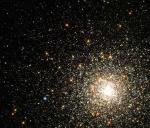 M80: A Dense Globular Cluster
7.07.1999
If our Sun were part of M80, the night sky would glow like a jewel box of bright stars. M80, also known as NGC 6093, is one of about 250 globular clusters that survive in our Galaxy.
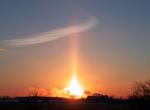 Launch of the Sun Pillar
23.01.2003
On January 16, NASA's space shuttle Columbia roared into blue morning skies above Kennedy Space Center on STS-107, the first shuttle mission of 2003. But this is not a picture of that launch!
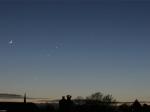 Mercury Over Leeds
7.03.2005
Have you ever seen the planet Mercury? This week might be a good time. Because Mercury orbits so close to the Sun, it never wanders far from the Sun in Earth's sky. If trailing the Sun, Mercury will be visible low on the horizon for only a short while after sunset.
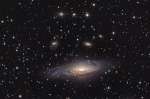 NGC 7331 and Beyond
24.10.2009
Big, beautiful spiral galaxy NGC 7331 is often touted as an analog to our own Milky Way. About 50 million light-years distant in the northern constellation Pegasus, NGC 7331 was recognized early on as a spiral nebula and is actually one of the brighter galaxies not included in Charles Messier's famous 18th century catalog.
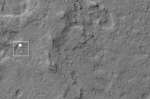 Curiosity Drops In
8.08.2012
Just as it captured the Phoenix lander parachuting to Mars in 2008, the HiRise camera onboard the Mars Reconnaissance Orbiter (MRO) snapped this picture of the Curiosity rover's spectacular descent toward its landing site on August 5 (PDT).
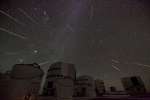 When Gemini Sends Stars to Paranal
15.12.2012
From a radiant point in the constellation of the Twins, the annual Geminid meteor shower rained down on planet Earth this week. Recorded near the shower's peak in the early hours of December...
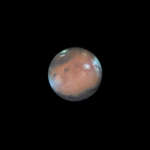 Mars near Opposition
11.04.2014
Tonight Mars is between opposition (April 8) and closest approach (April 14) looping through the constellation Virgo opposite the Sun in the night sky. That makes it prime season for telescopic views of the the Red Planet, like this one from April 3rd.
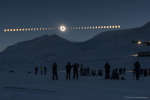 Total Solar Eclipse over Svalbard
20.04.2015
Going, going, gone. That was the feeling in Svalbard, Norway last month during a total eclipse of the Sun by the Moon. In the featured image, the eclipse was captured every three minutes and then digitally merged with a foreground frame taken from the same location.
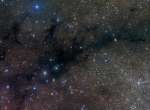 LDN 988 and Friends
24.09.2015
Stars are forming in dark, dusty molecular cloud LDN 988. Seen near picture center some 2,000 light-years distant, LDN 988 and other nearby dark nebulae were cataloged by Beverly T. Lynds in 1962 using Palomar Observatory Sky Survey plates.
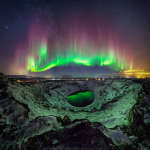 Colorful Aurora over Iceland
6.03.2017
You don't always see a scene this beautiful when you hike to an ancient volcano -- you have to be lucky. When the astrophotographer realized that aurora were visible two-weeks ago, he made a night-time run for the top of the caldera to see if he could capture them also reflected in the central lake.
|
January February March April May June July August September October |
|||||||||||||||||||||||||||||||||||||||||||||||||