
|
You entered: sky
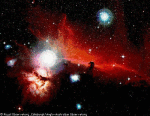 Orion's Horsehead Nebula
2.10.1996
The Horsehead Nebula is arguably the most famous nebula on the sky. It is visible as the black indentation to the red emission nebula seen just to the right of center of the above photograph. The bright star near the center is located in the belt of the familiar constellation of Orion.
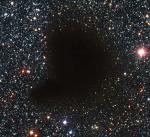 Molecular Cloud Barnard 68
11.05.1999
Where did all the stars go? What used to be considered a hole in the sky is now known to astronomers as a dark molecular cloud. Here, a high concentration of dust and molecular gas absorb practically all the visible light emitted from background stars.
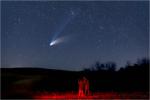 Hale Bopp: The Great Comet of 1997
31.03.2007
Ten short years ago, Comet Hale-Bopp rounded the Sun and offered a dazzling spectacle in planet Earth's night. This stunning view, recorded shortly after the comet's perihelion passage on April 1, 1997, features the memorable tails of Hale-Bopp -- a whitish dust tail and blue ion tail.
 The Tarantula Zone
26.04.2008
The Tarantula Nebula is more than 1,000 light-years in diameter -- a giant star forming region within our neighboring galaxy the Large Magellanic Cloud (LMC). That cosmic arachnid lies at the upper left of this expansive mosiac covering a part of the LMC over 6,000 light-years across.
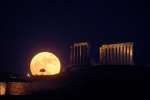 Solstice Moonrise, Cape Sounion
20.06.2008
Today's solstice marks the northernmost point of the Sun's annual motion through planet Earth's sky and the astronomical beginning of the northern hemisphere's summer. But only two days ago, the Full Moon nearest the solstice rose close to the ecliptic plane opposite the Sun, near its southernmost point for the year.
 NGC 6960: The Witch s Broom Nebula
19.08.2008
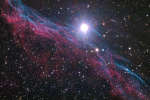
Ten thousand years ago, before the dawn of recorded human history, a new light must suddenly have appeared in the night sky and faded after a few weeks. Today we know this light was an exploding star and record the colorful expanding cloud as the Veil Nebula.
 The Tarantula Zone
16.09.2009
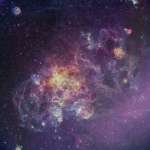
The Tarantula Nebula is more than 1,000 light-years in diameter -- a giant star forming region within our neighboring galaxy the Large Magellanic Cloud (LMC). That cosmic arachnid lies left of center in this in this colorful telescopic image taken through narrow-band filters. It covers a part of the LMC over 2,000 light-years across.
 Quadrantids over Qumis
14.01.2011
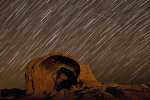
The Quadrantid Meteor Shower is an annual event for planet Earth's northern hemisphere skygazers. It usually peaks briefly in the cold, early morning hours of January 4. The shower is named for its radiant point on the sky within the old, astronomically obsolete constellation Quadrans Muralis.
 Otherworldly Planet Rise
11.04.2011
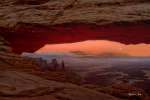
What would a sunrise look like on another world? So far, humanity has only recorded sunrises on Mars and Earth, but it is fun to wonder what they would look like on planets known and yet unknown.
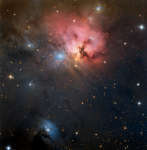 NGC 1579: Trifid of the North
9.03.2012
Colorful NGC 1579 resembles the better known Trifid Nebula, but lies much farther north in planet Earth's sky, in the heroic constellation Perseus. About 2,100 light-years away and 3 light-years across...
|
January February March April May June July August September October |
|||||||||||||||||||||||||||||||||||||||||||||||||