
|
You entered: sky
 APOD: 2023 April 26 Б The Moon through the Arc de Triomphe
26.04.2023
Was this a lucky shot? Although many amazing photographs are taken by someone who just happenedбto be in the right place at the right time, this image took skill and careful planning. First...
 APOD: 2023 May 9 Б Shadows of Earth
9.05.2023
Can you find two Earth shadows in today's image? It's a bit tricky. To find the first shadow, observe that the top part of the atmosphere appears pink and the lower part appears blue. This is because the top half is exposed to direct sunlight, while the lower part is not.
 NGC 7331 and Beyond
14.09.2023
Big, beautiful spiral galaxy NGC 7331 is often touted as an analog to our own Milky Way. About 50 million light-years distant in the northern constellation Pegasus, NGC 7331 was recognized early on as a spiral nebula and is actually one of the brighter galaxies not included in Charles Messier's famous 18th century catalog.
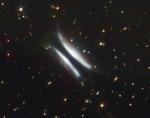 Gomezs Hamburger: A Proto Planetary Nebula
7.08.2002
What, in heaven, is that? Sometimes astronomers see things on the sky they don't immediately understand. In 1985 this happened to Arturo Gomez, and the object became known as Gomez's Hamburger for its distinctive yet familiar shape.
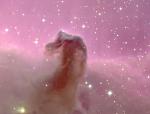 The Horsehead Nebula
13.07.2003
One of the most identifiable nebulae in the sky, the Horsehead Nebula in Orion, is part of a large, dark, molecular cloud. Also known as Barnard 33, the unusual shape was first discovered on a photographic plate in the late 1800s.
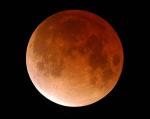 Sunset Moonlight
21.11.2003
November's lunar eclipse was one of the shortest in recent years and also one of the brightest -- demonstrating that the Earth's shadow is not completely dark. The eclipsed Moon remained easily visible...
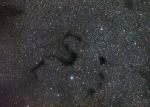 Snake in the Dark
21.05.2005
Dark nebulae snake across a gorgeous expanse of stars in this wide-field view toward the pronounceable constellation Ophiucus and the center of our Milky Way Galaxy. In fact, the central S-shape seen here is well known as the Snake Nebula.
 Chandra Resolves the Hard X Ray Background
14.01.2000
It is everywhere but nobody knew why. In every direction at all times, the sky glows in X-rays. The X-ray background phenomenon was discovered over 35 years ago, soon after the first X-ray satellites were launched, and has since gone unexplained.
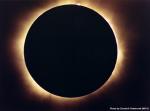 Sun Block
18.08.1999
During a total solar eclipse, Earth's moon blocks the sun - almost exactly. While the sun is about 400 times wider than the moon, it is also about 400 times farther away and each appears to be half a degree or so in diameter.
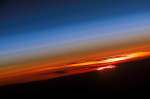 Sunset: Planet Earth
20.03.2008
Today, the Sun crosses the celestial equator heading north at 0548 UT. Known as the equinox, the geocentric astronomical event marks the first day of spring in the northern hemisphere and autumn in the south.
|
January February March April May June July August September October |
|||||||||||||||||||||||||||||||||||||||||||||||||