
|
You entered: sky
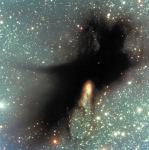 BHR 71: Stars, Clouds, and Jets
27.01.2003
What is happening to molecular cloud BHR 71? Quite possible, a binary star system is forming inside. Most stars in our Galaxy are part of binary star systems, but few have ever been seen in formation.
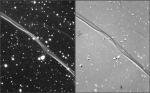 SN 1006: Historys Brightest Supernova
17.03.2003
Suddenly, in the year 1006 AD, a new star appeared in the sky. Over the course of just a few days, the rogue star became brighter than the planet Venus. The star, likely...
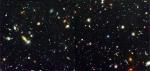 The Hubble Deep Field
7.06.1998
Galaxies like colorful pieces of candy fill the Hubble Deep Field - humanity's most distant yet optical view of the Universe. The dimmest, some as faint as 30th magnitude (about four billion times fainter...
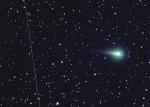 Announcing Comet C 2002 T7 LINEAR
9.02.2004
A newly discovered comet may outshine most stars in the sky by May. Designated Comet C/2002 T7 (LINEAR), the comet was discovered in 2002 October by project LINEAR. Many reports already place the comet as brighter than magnitude 7, meaning that it can now be seen with binoculars.
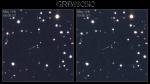 GRB 990510: Another Unusual Gamma Ray Burst
26.05.1999
Another huge explosion has lit up the universe, and astronomers are studying it as best they can before the light fades away. Two weeks ago, the BATSE instrument on the orbiting NASA Great Observatory Compton detected unusually bright flashes of gamma-rays from a point deep in the southern sky.
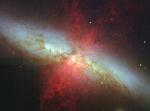 A Superwind from the Cigar Galaxy
4.04.2000
What's lighting up the Cigar Galaxy? M82, as this irregular galaxy is also known, was stirred up by a recent pass near large spiral galaxy M81. This doesn't fully explain the source of the red-glowing outwardly expanding gas, however.
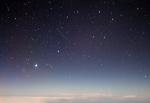 Aurigids from 47 000 Feet
5.09.2007
On September 1, Aurigid meteors filled the sky, in keeping with inovative predictions of an outburst from this historically tentative meteor shower. Astronomers flying at 47,000 feet on a dedicated mission to observer the outburst collected image data for this composite photo of the Aurigids' bright and colorful streaks.
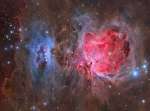 Great Orion Nebulae
23.10.2008
The Great Nebula in Orion, also known as M42, is one of the most famous nebulae in the sky. The star forming region's glowing gas clouds and hot young stars...
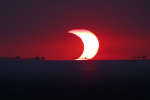 A Partial Eclipse Over Manila Bay
28.01.2009
What's happened to the setting Sun? An eclipse! Two days ago, the Moon eclipsed part of the Sun as visible from parts of Africa, Australia, and Asia. In particular the above image, taken from the Mall of Asia seawall, caught a partially eclipsed Sun setting over Manila Bay in the Philippines.
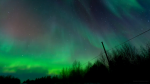 Time Lapse Auroras Over Norway
28.03.2011
Sometimes, after your eyes adapt to the dark, a spectacular sky appears. Such was the case earlier this month when one of the largest auroral displays in recent years appeared over northern locations like the border between Norway and Russia.
|
January February March April May June July August September October |
|||||||||||||||||||||||||||||||||||||||||||||||||