
|
You entered: sky
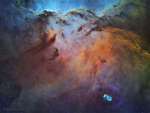 NGC 6188: Dragons of Ara
7.06.2022
Do dragons fight on the altar of the sky? Although it might appear that way, these dragons are illusions made of thin gas and dust. The emission nebula NGC 6188, home to the glowing...
 APOD: 2024 March 18 Б Comet Pons Brooks Swirling Coma
18.03.2024
A bright comet will be visible during next month's total solar eclipse. This very unusual coincidence occurs because Comet 12P/Pons-Brooks's return to the inner Solar System places it by chance only 25 degrees away from the Sun during Earth's April 8 total solar eclipse.
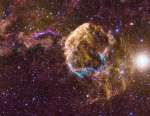 Sibling Supernova Remnants
2.07.2026
What happens when one of the stars in a binary goes supernova? This image combines visible (yellow), ultraviolet (purple) and infrared light (cyan, red and orange) to show two supernova remnants and their surrounding environment, about 6,000 light-years away. The younger one is the well-known Jellyfish Nebula in the center (mostly in yellow).
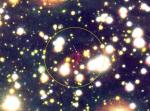 375: Candidate Quark Star
14.04.2002
Why is RJX J185635-375 so cool and so dim? Previously, this compact star held claim to being the closest neutron star -- only 150 light-years away. Now new observations and analysis indicate not only a cool temperature for RXJ J185635-375, pictured above, but also a larger distance: roughly 450 light-years away.
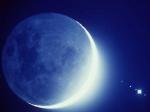 Tonight: A Blue Moon
31.07.2004
How often does a full moon occur twice in a single month? Exactly once in a Blue Moon. In fact, the modern usage of the term "Blue Moon" refers to the second Full Moon in a single month. Tonight's Blue Moon will be the first since November 2001.
 A Lunar Eclipse on Solstice Day
20.12.2010
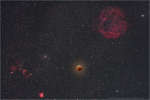
Sometime after sunset tonight, the Moon will go dark. This total lunar eclipse, where the entire Moon is engulfed in the shadow of the Earth, will be visible from all of North America, while the partial phase of this eclipse will be visible throughout much of the rest of the world.
 Zodiacal Light Panorama
5.04.2012
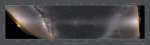
Sweeping from the eastern to western horizon, this 360 degree panorama follows the band of zodiacal light along the solar system's ecliptic plane. Dust scattering sunlight produces the faint zodiacal glow that spans...
 Pickering s Triangle in the Veil
17.09.2015
Chaotic in appearance, these filaments of shocked, glowing gas break across planet Earth's sky toward the constellation of Cygnus, as part of the Veil Nebula. The Veil Nebula itself is a large supernova remnant, an expanding cloud born of the death explosion of a massive star.
 Williamina Fleming s Triangular Wisp
10.11.2017
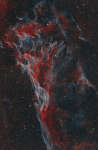
Chaotic in appearance, these tangled filaments of shocked, glowing gas are spread across planet Earth's sky toward the constellation of Cygnus as part of the Veil Nebula. The Veil Nebula itself is a large supernova remnant, an expanding cloud born of the death explosion of a massive star.
 APOD: 2025 June 21 Б Two Worlds, Two Analemmas
21.06.2025
Sure, that figure-8 shaped curve you get when you mark the position of the Sun in Earth's sky at the same time each day over one year is called an analemma.
|
January February March April May June July August September October |
|||||||||||||||||||||||||||||||||||||||||||||||||