
|
You entered: sky
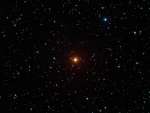 La Superba
18.12.2008
Y Canum Venaticorum (Y CVn) is a very rare star in planet Earth's night sky. It's also very red, exhibiting such a remarkable spectrum of light, 19th century astronomer Angelo Secchi dubbed it La Superba.
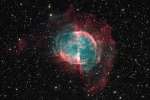 M27: Not a Comet
26.08.2010
While hunting for comets in the skies above 18th century France, astronomer Charles Messier diligently kept a list of the things he encountered that were definitely not comets. This is number 27 on his now famous not-a-comet list.
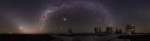 Wonder and Mystery above the Very Large Telescopes
9.05.2011
What's that bright orange dot above the large telescope on the right? Even seasoned sky enthusiasts might ponder the origin of the orange orb seen by scrolling across this panoramic image, taken last December. Perhaps identifying known objects will help.
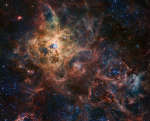 The Tarantula Nebula
26.02.2016
The Tarantula Nebula is more than a thousand light-years in diameter, a giant star forming region within nearby satellite galaxy the Large Magellanic Cloud, about 180 thousand light-years away. The largest, most violent star...
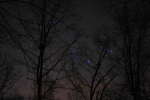 The Fainting of Betelgeuse
2.01.2020
Begirt with many a blazing star, Orion the Hunter is one of the most recognizable constellations. In this night skyscape the Hunter's stars rise in the northern hemisphere's winter sky on December 30, 2019, tangled in bare trees near Newnan, Georgia, USA.
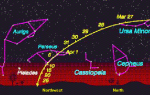 Comet Hyakutake Finder Chart for Early April
31.03.1996
During April Comet Hyakutake heads in toward the Sun after passing the Earth. At this time the comet's orbit places it north of the Earth. Remaining visible in the northern sky as it nears the Sun, it will set progressively earlier in the evening.
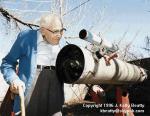 Clyde W. Tombaugh: 1906-1997
4.02.1997
Astronomer Clyde Tombaugh, discoverer of Pluto, died on January 17th. Inspiring many during his long and exceptional career, he had been living in Las Cruces, New Mexico with his wife of 60 years, Patsy. Today would have been his 91st birthday.
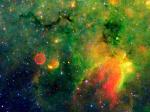 A Galactic Star Forming Region in Infrared
24.09.2007
How do stars form? To help study this complex issue, astronomers took a deep image in infrared light of an active part of our Milky Way Galaxy where star formation is rampant. In IRDC G11.11-0
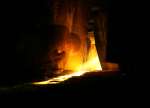 Solstice at Newgrange
20.12.2008
Tomorrow's solstice marks the southernmost point of the Sun's annual motion through planet Earth's sky and the astronomical beginning of winter in the north. In celebration of the northern winter solstice...
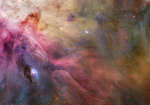 LL Ori and the Orion Nebula
3.02.2013
This esthetic close-up of cosmic clouds and stellar winds features LL Orionis, interacting with the Orion Nebula flow. Adrift in Orion's stellar nursery and still in its formative years, variable star LL Orionis produces a wind more energetic than the wind from our own middle-aged Sun.
|
January February March April May June July August September October |
|||||||||||||||||||||||||||||||||||||||||||||||||