
|
You entered: sky
 APOD: 2023 September 10 Б An Annular Solar Eclipse over New Mexico
10.09.2023
What is this person doing? In 2012, an annular eclipse of the Sun was visible over a narrow path that crossed the northern Pacific Ocean and several western US states. In an annular solar...
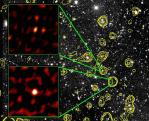 Distant Galaxies in Radio Vision
8.02.2001
Radio waves, like visible light, are electromagnetic radiation and radio telescopes can "see" -- their signals translated into radio images of the cosmos. While individually even the largest radio telescopes have very blurry vision compared to their optical counterparts, networks of radio telescopes can combine signals to produce sharper pictures.
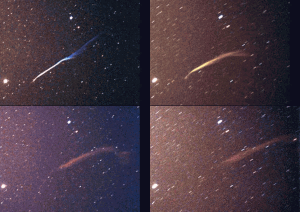 Meteor Storm Sights and Sounds
30.11.2001
This dramatic four-frame animation shows a fireball meteor and its developing persistent "smoke" train, recorded two weeks ago in skies near Salvador, Brazil. Indeed similar sights are astonishingly familiar world-wide to witnesses of this November's fireball-rich Leonid meteor storm.
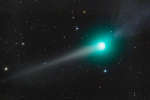 Two Tails of Comet Lulin
25.02.2009
Go outside tonight and see Comet Lulin. From a dark location, you should need only a good star map and admirable perseverance -- although wide-field binoculars might help. Yesterday, Comet Lulin passed its closest to Earth, so that the comet will remain near its brightest over the next few days.
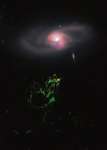 Hanny s Voorwerp
10.02.2011
Hanny's Voorwerp, Dutch for "Hanny's Object", is enormous, about the size of our own Milky Way Galaxy. Glowing strongly in the greenish light produced by ionized oxygen atoms, the mysterious voorwerp is below spiral galaxy IC 2497 in this view from the Hubble Space Telescope.
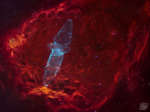 Ou4: A Giant Squid in a Flying Bat
7.10.2020
A very faint but very large squid-like nebula is visible in planet Earth's sky -- but inside a still larger bat. The Giant Squid Nebula cataloged as Ou4, and Sh2-129 also known as the Flying Bat Nebula, are both caught in this cosmic scene toward the royal royal constellation Cepheus.
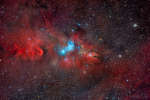 Fox Fur, Unicorn, and Christmas Tree
26.12.2020
Clouds of glowing hydrogen gas fill this colorful skyscape in the faint but fanciful constellation Monoceros, the Unicorn. A star forming region cataloged as NGC 2264, the complex jumble of cosmic gas and dust...
 M51 in 255 Hours
11.08.2023
An intriguing pair of interacting galaxies, M51 is the 51st entry in Charles Messier's famous catalog. Perhaps the original spiral nebula, the large galaxy with whirlpool-like spiral structure seen nearly face-on is also cataloged as NGC 5194. Its spiral arms and dust lanes sweep in front of a companion galaxy (right), NGC 5195.
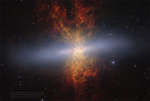 APOD: 2026 June 29 Б M82: Galaxy with a Supergalactic Wind
29.06.2026
Why is the Cigar Galaxy billowing red smoke? M82, as this starburst galaxy is also known, was stirred up by a recent pass near large spiral galaxy M81. This doesn't fully explain the source of the red-glowing outwardly expanding gas and dust, however.
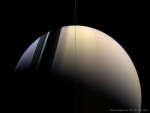 Saturn in Blue and Gold
29.08.2017
Why is Saturn partly blue? The featured picture of Saturn approximates what a human would see if hovering close to the giant ringed world. The image was taken in 2006 March by the robot Cassini spacecraft now orbiting Saturn. Here Saturn's majestic rings appear directly only as a thin vertical line.
|
January February March April May June July August September October |
|||||||||||||||||||||||||||||||||||||||||||||||||