
|
You entered: sky
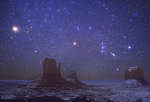 Mars and Orion Over Monument Valley
25.12.2007
Welcome to The World At Night. Sharing the night sky seen around the world, this view from Monument Valley, USA includes a picturesque foreground of famous buttes. Buttes are composed of hard volcanic rock left behind after water eroded away the surrounding soft rock.
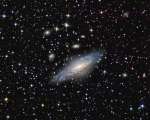 NGC 7331 and Beyond
12.07.2008
Big, beautiful spiral galaxy NGC 7331 is often touted as an analog to our own Milky Way. About 50 million light-years distant in the northern constellation Pegasus, NGC 7331 was recognized early on as a spiral nebula and is actually one of the brighter galaxies not included in Charles Messier's famous 18th century catalog.
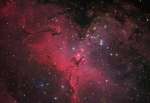 M16 and the Eagle Nebula
19.07.2008
Young star cluster M16 is surrounded by natal clouds of cosmic dust and glowing gas also known as The Eagle Nebula. This beautifully detailed image of the region includes fantastic shapes made famous in well-known Hubble Space Telescope close-ups of the starforming complex.
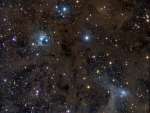 Stardust in Aries
25.11.2010
This composition in stardust covers almost 2 degrees on the sky, close to the border of the zodiacal constellation Aries and the plane of our Milky Way Galaxy. At the lower right...
 Around the World in 90 Minutes
21.11.2011
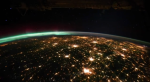
What is it like to circle the Earth? Every 90 minutes, astronauts aboard the International Space Station experience just that. Recently, crew members took a series of light-sensitive videos looking down at night that have been digitally fused to produce the above time-lapse video.
 Orion Over and Under Tibet
5.10.2015
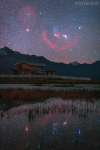
This night was so serene you could see Orion rise downwards. The unusual spectacle was captured in this single-exposure image, featuring a deep sky around the famous constellation of Orion that appeared both above -- and reflected in -- a peaceful lake in the Gyirong Valley of Tibet, China.
 Dark Nebula LDN 1622 and Barnards Loop
6.04.2017
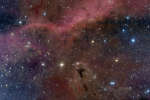
The silhouette of an intriguing dark nebula inhabits this cosmic scene. Lynds' Dark Nebula (LDN) 1622 appears below center against a faint background of glowing hydrogen gas only easily seen in long telescopic exposures of the region.
 M51: The Whirlpool Galaxy
19.10.2017
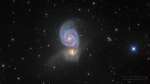
Find the Big Dipper and follow the handle away from the dipper's bowl until you get to the last bright star. Then, just slide your telescope a little south and west and you'll come upon this stunning pair of interacting galaxies, the 51st entry in Charles Messier's famous catalog.
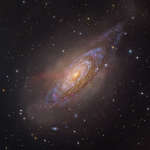 NGC 3521: Galaxy in a Bubble
5.05.2022
Gorgeous spiral galaxy NGC 3521 is a mere 35 million light-years away, toward the northern springtime constellation Leo. Relatively bright in planet Earth's sky, NGC 3521 is easily visible in small telescopes but often overlooked by amateur imagers in favor of other Leo spiral galaxies, like M66 and M65.
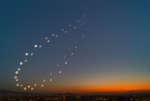 A Double Lunar Analemma over Turkey
10.10.2022
An analemma is that figure-8 curve you get when you mark the position of the Sun at the same time each day for one year. But the trick to imaging an analemma of the Moon is to wait bit longer.
|
January February March April May June July August September October |
|||||||||||||||||||||||||||||||||||||||||||||||||