
|
You entered: sky
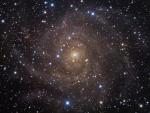 Hidden Galaxy IC 342
5.10.2006
Similar in size to other large, bright spiral galaxies IC 342 is a mere 7 million light-years distant in the long-necked, northern constellation Camelopardalis. A sprawling island universe, IC 342 would otherwise...
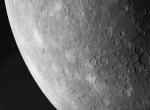 Southwest Mercury
13.02.2000
The planet Mercury resembles a moon. Mercury's old surface is heavily cratered like many moons. Mercury is larger than most moons but smaller than Jupiter's moon Ganymede and Saturn's moon Titan. Mercury is much denser and more massive than any moon, though, because it is made mostly of iron.
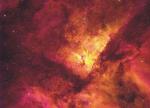 NGC 3372: The Great Nebula in Carina
19.07.1999
In one of the brightest parts of the Milky Way lies a nebula where some of the oddest things occur. NGC 3372, known as the Great Nebula in Carina, is home to massive stars and changing nebula.
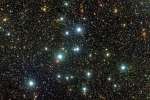 M39: Open Cluster in Cygnus
12.04.2009
Lying just at the limit of human perception is a picturesque starfield containing one of the larger open clusters on the northern sky. Spanning an angle larger than the Moon, M39's relatively few stars lie only about 800 light years distant toward the constellation of Cygnus.
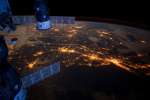 Yuri s Planet
12.04.2013
On another April 12th, in 1961, Soviet cosmonaut Yuri Alexseyevich Gagarin became the first human to see planet Earth from space. Commenting on his view from orbit he reported, "The sky is very dark; the Earth is bluish. Everything is seen very clearly".
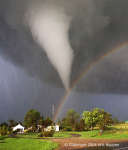 Tornado and Rainbow Over Kansas
22.11.2014
The scene might have been considered serene if it weren't for the tornado. During 2004 in Kansas, storm chaser Eric Nguyen photographed this budding twister in a different light -- the light of a rainbow. Featured here, a white tornado cloud descends from a dark storm cloud.
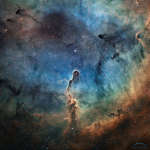 The Elephants Trunk in IC 1396
13.10.2015
Like an illustration in a galactic Just So Story, the Elephant's Trunk Nebula winds through the emission nebula and young star cluster complex IC 1396, in the high and far off constellation of Cepheus. Of course, the cosmic elephant's trunk is over 20 light-years long.
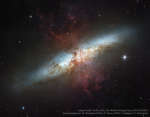 M82: Galaxy with a Supergalactic Wind
21.02.2016
What's lighting up the Cigar Galaxy? M82, as this irregular galaxy is also known, was stirred up by a recent pass near large spiral galaxy M81. This doesn't fully explain the source of the red-glowing outwardly expanding gas, however.
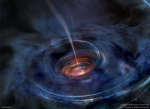 Black Hole Accreting with Jet
27.03.2017
What happens when a black hole devours a star? Many details remain unknown, but recent observations are providing new clues. In 2014, a powerful explosion was recorded by the ground-based robotic telescopes of the All Sky Automated Survey for SuperNovae (ASAS-SN) project, and followed up by instruments including NASA's Earth-orbiting Swift satellite.
 Comet ATLAS Breaks Up
16.04.2020
Cruising through the inner solar system, Comet ATLAS C2019/Y4 has apparently fragmented. Multiple separate condensations within its diffuse coma are visible in this telescopic close-up from April 12, composed of frames tracking the comet's motion against trailing background stars.
|
January February March April May June July August September October |
|||||||||||||||||||||||||||||||||||||||||||||||||