
|
You entered: distance
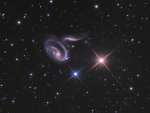 Arp 273
15.11.2008
The two prominent stars in the foreground of this colorful skyscape are well within our own Milky Way Galaxy. Their spiky appearance is due to diffraction in the astronomer's telescope. But the two eye-catching galaxies in view lie far beyond the Milky Way, at a distance of about 200 million light-years.
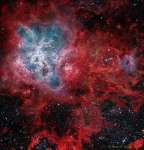 The Cosmic Web of the Tarantula Nebula
8.11.2016
It is the largest and most complex star forming region in the entire galactic neighborhood. Located in the Large Magellanic Cloud, a small satellite galaxy orbiting our Milky Way galaxy, the region's spidery appearance is responsible for its popular name, the Tarantula nebula. This tarantula, however, is about 1,000 light-years across.
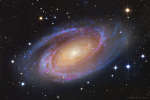 Bright Spiral Galaxy M81
17.09.2017
One of the brightest galaxies in planet Earth's sky is similar in size to our Milky Way Galaxy: big, beautiful M81. This grand spiral galaxy can be found toward the northern constellation of the Great Bear (Ursa Major).
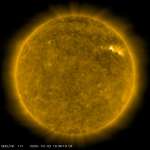 Driving to the Sun
3.10.2020
How long would it take to drive to the Sun? Brittany age 7, and D.J. age 12, ponder this question over dinner one evening. James also age 7, suggests taking a really fast racing car while Christopher age 4, eagerly agrees.
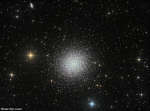 M13: The Great Globular Cluster in Hercules
4.08.2022
In 1716, English astronomer Edmond Halley noted, "This is but a little Patch, but it shows itself to the naked Eye, when the Sky is serene and the Moon absent." Of course...
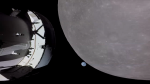 Earthset from Orion
23.11.2022
Eight billion people are about to disappear in this snapshot from space. Taken on November 21, the sixth day of the Artemis 1 mission, their home world is setting behind the Moon's bright edge as viewed by an external camera on the outbound Orion spacecraft.
 Facing NGC 1232
18.04.2024
From our vantage point in the Milky Way Galaxy, we see NGC 1232 face-on. Nearly 200,000 light-years across, the big, beautiful spiral galaxy is located some 47 million light-years away in the flowing southern constellation of Eridanus. This sharp, multi-color, telescopic image of NGC 1232 includes remarkable details of the distant island universe.
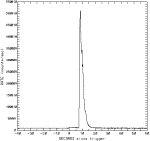 BATSE's Biggest Gamma Ray Burst (Yet)
1.10.1996
Something big exploded but astronomers have no idea what. On September 24th, the Burst and Transient Source Experiment (BATSE) onboard the orbiting Compton Gamma Ray Observatory recorded the most intense gamma ray burst in its five year history.
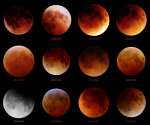 Twelve Lunar Eclipses
29.02.2008
Welcome to the extra day in the Gregorian Calendar's leap year 2008! To celebrate, consider this grid of lunar eclipse pictures - starting in leap year 1996 and ending with February's eclipse - with the date in numerical year/month/day format beneath each image.
 Shaping NGC 6188
16.07.2010
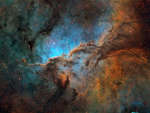
Dark shapes with bright edges winging their way through dusty NGC 6188 are tens of light-years long. The emission nebula is found near the edge of an otherwise dark large molecular cloud in the southern constellation Ara, about 4,000 light-years away.
|
January February March April May |
|||||||||||||||||||||||||||||||||||||||||||||||||