
|
You entered: distance
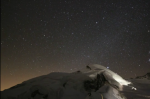 Geostationary Satellites Beyond the Alps
11.04.2012
Why don't those stars move? Stars in the sky will typically appear to rise and set as the Earth turns. Those far to the north or south will appear to circle the pole. If you look closely at the above time-lapse movie, however, there are points of light that appear stationary.
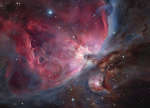 At the Heart of Orion
1.01.2015
Near the center of this sharp cosmic portrait, at the heart of the Orion Nebula, are four hot, massive stars known as the Trapezium. Tightly gathered within a region about 1.5 light-years in radius, they dominate the core of the dense Orion Nebula Star Cluster.
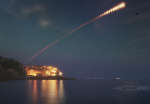 Eclipse over the Gulf of Poets
2.08.2018
The total phase of the July 27 lunar eclipse lasted for an impressive 103 minutes. That makes it the longest total lunar eclipse of the 21st century. The Moon passed through the center of Earth's shadow while the Moon was near apogee, the most distant point in its elliptical orbit.
 The Orion Bullets
3.03.2019
Why are bullets of gas shooting out of the Orion Nebula? Nobody is yet sure. First discovered in 1983, each bullet is actually about the size of our Solar System, and moving at about 400 km/sec from a central source dubbed IRc2.
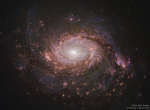 M77: Spiral Galaxy with an Active Center
17.03.2020
What's happening in the center of nearby spiral galaxy M77? The face-on galaxy lies a mere 47 million light-years away toward the constellation of the Sea Monster (Cetus). At that estimated distance, this gorgeous island universe is about 100 thousand light-years across.
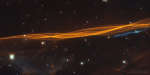 Filaments of the Cygnus Loop
28.09.2020
What lies at the edge of an expanding supernova? Subtle and delicate in appearance, these ribbons of shocked interstellar gas are part of a blast wave at the expanding edge of a violent stellar explosion that would have been easily visible to humans during the late stone age, about 20,000 years ago.
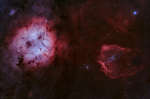 Elephant, Bat, and Squid
23.07.2021
Sprawling emission nebulae IC 1396 and Sh2-129 mix glowing interstellar gas and dark dust clouds in this 10 degree wide field of view toward the northern constellation Cepheus the King. Energized by its bluish central star IC 1396 (left) is hundreds of light-years across and some 3,000 light-years distant.
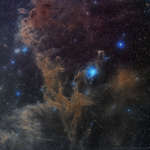 Chamaeleon Dark Nebulas
17.01.2022
Sometimes the dark dust of interstellar space has an angular elegance. Such is the case toward the far-south constellation of Chamaeleon. Normally too faint to see, dark dust is best known for blocking visible light from stars and galaxies behind it.
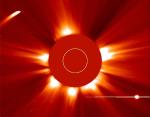 Sunbather
11.01.2002
Intense and overwhelming, the direct glare of the Sun is blocked by the smooth disk centered in this image from the sun-staring SOHO spacecraft. Taken on January 8, the picture shows streamers of solar wind billowing radially outward for millions of kilometers above the Sun's surface indicated by the white circle.
 International Space Station in Transit
9.05.2003
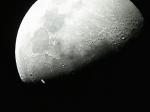
A stunning telescopic image of the International Space Station crossing in front of an eight day old Moon, this picture was captured on April 11th. But while Wednesday's leisurely transit of Mercury across the Sun entertained observers all over the dayside of planet Earth, the audience for this lunar transit was more restricted.
|
January February March April May |
|||||||||||||||||||||||||||||||||||||||||||||||||