
|
You entered: distance
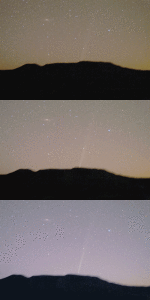 Comet Bradfield Rising
27.04.2004
Comet Bradfield has become quite a sight just before sunrise -- for those with binoculars or cameras. Although fading noticeably each day, a sky chart, a northern location, and some persistence will allow curious sky gazers to locate the cosmic snowball and its spectacular tail.
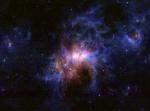 Dusty Environs of Eta Carinae
15.10.2005
Eta Car is a massive star, but it's not as bright as it used to be. Now only easily visible in binoculars or a small telescope, Eta Carinae has a history of spectacular flaring and fading behavior.
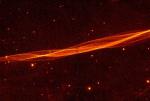 Filaments In The Cygnus Loop
26.04.2000
Subtle and delicate in appearance, these are filaments of shocked interstellar gas -- part of the expanding blast wave from a violent stellar explosion. Recorded in November 1997 with the Wide Field and Planetary Camera 2 onboard the Hubble Space Telescope, the picture is a closeup of a supernova remnant known as the Cygnus Loop.
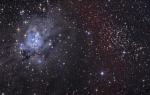 NGC 7129 and NGC 7142
13.09.2007
This alluring telescopic image looks toward the constellation Cepheus and an intriguing visual pairing of dusty reflection nebula NGC 7129 (left) and open star cluster NGC 7142. The two appear separated by only half a degree on the sky, but they actually lie at quite different distances.
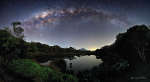 Milky Way Over Piton de lEau
25.06.2012
Sometimes, if you wait long enough for a clear and moonless night, the stars will come out with a vengeance. One such occasion occurred earlier this month at the Piton de l'Eau on Reunion Island. In the foreground, surrounded by bushes and trees, lies a water filled volcanic crater serenely reflecting starlight.
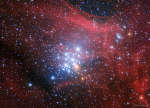 NGC 3293: A Bright Young Star Cluster
6.04.2015
Hot blue stars shine brightly in this beautiful, recently formed galactic or "open" star cluster. Open cluster NGC 3293 is located in the constellation Carina, lies at a distance of about 8000 light years, and has a particularly high abundance of these young bright stars.
 Trio Leo
9.05.2015
This popular group is famous as the Leo Triplet - a gathering of three magnificent galaxies in one field of view. Crowd pleasers when imaged with even modest telescopes, they can be introduced individually as NGC 3628 (left), M66 (bottom right), and M65 (top).
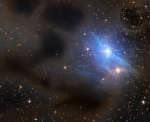 Reflections on vdB 31
11.03.2017
Riding high in the constellation of Auriga, beautiful, blue vdB 31 is the 31st object in Sidney van den Bergh's 1966 catalog of reflection nebulae. It shares this well-composed celestial still life with dark, obscuring clouds recorded in Edward E. Barnard's 1919 catalog of dark markings in the sky.
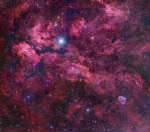 Central Cygnus Skyscape
22.03.2017
In cosmic brush strokes of glowing hydrogen gas, this beautiful skyscape unfolds across the plane of our Milky Way Galaxy near the northern end of the Great Rift and the center of the constellation Cygnus the Swan. A 36 panel mosaic of telescopic image data, the scene spans about six degrees.
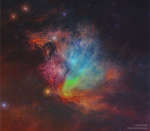 APOD: 2023 February 19 Б Seven Dusty Sisters in Infrared
19.02.2023
Is this really the famous Pleiades star cluster? Known for its iconic blue stars, the Pleiades is shown here in infrared light where the surrounding dust outshines the stars. Here three infrared colors have been mapped into visual colors (R=24, G=12, B=4.6 microns).
|
January February March April May |
|||||||||||||||||||||||||||||||||||||||||||||||||