
|
You entered: distance
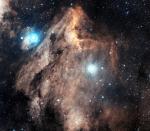 A Pelican in the Swan
30.11.2006
The Pelican Nebula lies about 2,000 light-years away in the high flying constellation Cygnus, the Swan. Also known as IC 5070, this cosmic pelican is appropriately found just off the "east coast" of the North America Nebula (NGC 7000), another surprisingly familiar looking emission nebula in Cygnus.
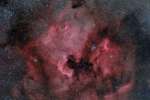 North America and the Pelican
3.09.2013
Here lie familiar shapes in unfamiliar locations. On the left is an emission nebula cataloged as NGC 7000, famous partly because it resembles our fair planet's continent of North America. The emission region to the right of the North America Nebula is IC 5070, also known for its suggestive outlines as the Pelican Nebula.
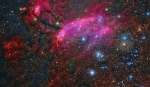 IC 4628: The Prawn Nebula
9.12.2016
South of Antares, in the tail of the nebula-rich constellation Scorpius, lies emission nebula IC 4628. Nearby hot, massive stars, millions of years young, irradiate the nebula with invisible ultraviolet light, stripping electrons from atoms. The electrons eventually recombine with the atoms to produce the visible nebular glow, dominated by the red emission of hydrogen.
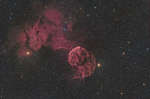 Sharpless 249 and the Jellyfish Nebula
23.03.2018
Normally faint and elusive, the Jellyfish Nebula is caught in this alluring telescopic image. Centered in the scene it's anchored right and left by two bright stars, Mu and Eta Geminorum, at the foot of the celestial twin. The Jellyfish Nebula is the brighter arcing ridge of emission with dangling tentacles.
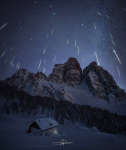 Gemini s Meteors
17.12.2020
Taken over the course of an hour shortly after local midnight on December 13, 35 exposures were used to create this postcard from Earth. The composited night scene spans dark skies above the snowy Italian Dolomites during our fair planet's annual Geminid meteor shower.
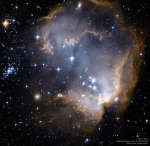 NGC 602 and Beyond
16.05.2021
The clouds may look like an oyster, and the stars like pearls, but look beyond. Near the outskirts of the Small Magellanic Cloud, a satellite galaxy some 200 thousand light-years distant, lies 5 million year young star cluster NGC 602.
 APOD: 2023 June 13 Б Moons Across Jupiter
13.06.2023
Jupiter's moons circle Jupiter. The featured video depicts Europa and Io, two of Jupiter's largest moons, crossing in front of the grand planet's Great Red Spot, the largest known storm system in our Solar System.
 APOD: 2024 September 29 Б Seven Dusty Sisters
29.09.2024
Is this really the famous Pleiades star cluster? Known for its iconic blue stars, the Pleiades is shown here in infrared light where the surrounding dust outshines the stars. Here, three infrared colors have been mapped into visual colors (R=24, G=12, B=4.6 microns).
 APOD: 2024 October 29 Б NGC 602: Stars Versus Pillars from Webb
29.10.2024
The stars are destroying the pillars. More specifically, some of the newly formed stars in the image center are emitting light so energetic that is evaporating the gas and dust in the surrounding pillars. Simultaneously, the pillars themselves are still trying to form new stars.
 APOD: 2025 November 19 Б Chamaeleon Dark Nebulas
19.11.2025
Sometimes the dark dust of interstellar space has an angular elegance. Such is the case toward the far-south constellation of Chamaeleon. Normally too faint to see, dark dust is best known for blocking visible light from stars and galaxies behind it.
|
January February March April May |
|||||||||||||||||||||||||||||||||||||||||||||||||