
|
You entered: distance
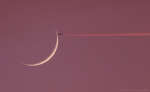 Fly Me to the Moon
17.01.2017
No, this is not a good way to get to the Moon. What is pictured is a chance superposition of an airplane and the Moon. The contrail would normally appear white, but the large volume of air toward the setting Sun preferentially knocks away blue light, giving the reflected trail a bright red hue.
 APOD: 2023 May 3 Б Centaurus A: A Peculiar Island of Stars
3.05.2023
Galaxies are fascinating. In galaxies, gravity alone holds together massive collections of stars, dust, interstellar gas, stellar remnants and dark matter. Pictured is NGC 5128, better known as Centaurus A. Cen A is the fifth brightest galaxy on the sky and is located at a distance of about 12 million light years from Earth.
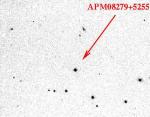 APM 08279+5255: The Brightest Object Yet Known
18.08.1998
It shines with the brightness of 100 billion Suns. Is it a mirage? The recently discovered quasar labeled APM 08279+5255 has set a new record as being the brightest continuously emitting object yet known.
 Gamma Ray Bursts from the Unknown
23.11.1996
Gamma Ray Bursts (GRBs) pose one of the greatest mysteries of modern astronomy. About once a day, the gamma-ray sky lights up with a spectacular explosion. No one knows what causes these explosions or even how far away they are.
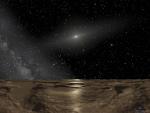 Sedna at Noon
4.06.2004
Standing on Sedna - the solar system's most distant known planetoid - your view of the Sun at high noon might look something like this. An artist's dramatic vision, the picture shows the Sun suspended above the nearby horizon as a bright star immersed in the dusty ecliptic plane.
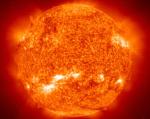 Driving To The Sun
12.12.1998
How long would it take to drive to the Sun? Brittany, age 7, and D.J., age 12, ponder this question over dinner one evening. James, also age 7, suggests taking a really fast racing car while Christopher, age 4, eagerly agrees.
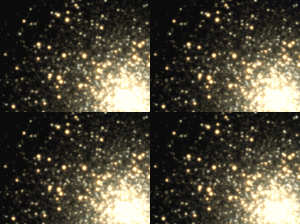 M3: Inconstant Star Cluster
12.10.2004
Star clusters appear constant because photographs of them are frozen in time. In reality, though, cluster stars swarm the center and frequently fluctuate in brightness. Although the time it takes for stars to cross...
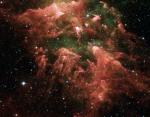 Sculpting the South Pillar
2.06.2005
Eta Carinae, one of the most massive and unstable stars in the Milky Way Galaxy, has a profound affect on its environment. Found in the the South Pillar region of the Carina Nebula, these...
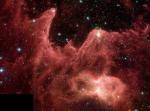 Mountains of Creation
11.11.2005
This fantastic skyscape lies at the eastern edge of giant stellar nursery W5, about 7,000 light-years away in the constellation Cassiopeia. An infrared view from the Spitzer Space Telescope, it features interstellar clouds...
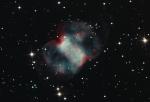 Messier 76
2.11.2006
"Nebula at the right foot of Andromeda ... " begins the description for the 76th object in Charles Messier's 18th century Catalog of Nebulae and Star Clusters. In fact, M76 is one of the fainter objects on the Messier list and is also known by the popular name of the "Little Dumbbell Nebula".
|
January February March April May |
|||||||||||||||||||||||||||||||||||||||||||||||||