
|
You entered: distance
 WR 104: A Pinwheel Star System
3.06.2014
Might this giant pinwheel one-day destroy us? Probably not, but investigation of the unusual star system Wolf-Rayet 104 has turned up an unexpected threat. The unusual pinwheel pattern has been found to be created by energetic winds of gas and dust that are expelled and intertwine as two massive stars orbit each other.
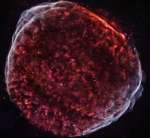 X rays from Supernova Remnant SN 1006
23.04.2013
What looks like a puff-ball is surely the remains of the brightest supernova in recorded human history. In 1006 AD, it was recorded as lighting up the nighttime skies above areas now known as China, Egypt, Iraq, Italy, Japan, and Switzerland.
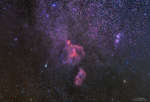 Comet Heart and Soul
22.08.2018
The greenish coma of comet 21P/Giacobini-Zinner stands out at the left of this telephoto skyscape spanning over 10 degrees toward the northern constellations Cassiopeia and Perseus. Captured on August 17, the periodic comet is the known parent body of the upcoming Draconid meteor shower.
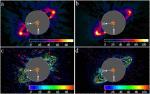 HR 4796A: Not Saturn
4.02.1999
These are not false-color renderings of the latest observations of Saturn's magnificent rings. Instead, the panels show a strikingly similar system on a much larger scale - a ring around the young, Vega-like star, HR 4796A, located about 200 light-years from Earth.
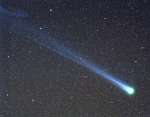 Comet Hyakutake Passes the Earth
15.12.2009
In 1996, an unexpectedly bright comet passed by planet Earth. Discovered less than two months before, Comet C/1996 B2 Hyakutake came within only 1/10th of the Earth-Sun distance from the Earth in late March.
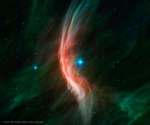 Zeta Oph: Runaway Star
1.02.2020
Like a ship plowing through cosmic seas, runaway star Zeta Ophiuchi produces the arcing interstellar bow wave or bow shock seen in this stunning infrared portrait. In the false-color view, bluish Zeta...
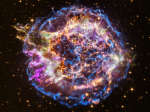 Recycling Cassiopeia A
5.09.2019
Massive stars in our Milky Way Galaxy live spectacular lives. Collapsing from vast cosmic clouds, their nuclear furnaces ignite and create heavy elements in their cores. After a few million years, the enriched material is blasted back into interstellar space where star formation can begin anew.
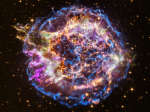 Recycling Cassiopeia A
22.01.2021
Massive stars in our Milky Way Galaxy live spectacular lives. Collapsing from vast cosmic clouds, their nuclear furnaces ignite and create heavy elements in their cores. After a few million years, the enriched material is blasted back into interstellar space where star formation can begin anew.
 Recycling Cassiopeia A
31.05.2023
Massive stars in our Milky Way Galaxy live spectacular lives. Collapsing from vast cosmic clouds, their nuclear furnaces ignite and create heavy elements in their cores. After a few million years, the enriched material is blasted back into interstellar space where star formation can begin anew.
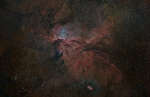 NGC 6188 and NGC 6164
1.02.2014
Fantastic shapes lurk in clouds of glowing gas in NGC 6188, about 4,000 light-years away. The emission nebula is found near the edge of a large molecular cloud unseen at visible wavelengths, in the southern constellation Ara.
|
January February March April May June July August September |
|||||||||||||||||||||||||||||||||||||||||||||||||