
|
You entered: distance
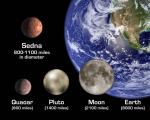 APOD: 2004 August 27- The Sedna Scenario
27.08.2004
The discovery of Sedna (aka 2003 VB12), the most distant known object orbiting the Sun, presents a mystery. Pluto's orbit averages about 40 AU in radius, where an AU (Astronomical Unit) is the Earth-Sun distance.
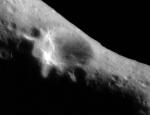 Eros From Orbit
16.02.2000
On February 14th, the NEAR spacecraft became the first artificial moon of an asteroid. Captured by the gentle gravity of a 20 mile long slipper-shaped mountain of rock, NEAR recorded this premier image while orbiting asteroid 433 Eros at a distance of about 200 miles.
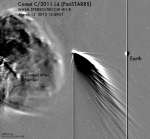 CME, Comet, and Planet Earth
15.03.2013
After appearing in a popular photo opportunity with a young crescent Moon near sunset, naked-eye Comet PanSTARRS continues to rise in northern hemisphere skies. But this remarkable interplanetary perspective from March 13, finds the comet posing with our fair planet itself - as seen from the STEREO Behind spacecraft.
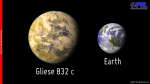 Gliese 832c: The Closest Potentially Habitable Exoplanet
9.07.2014
This planet is only 16 light years away -- could it harbor life? Recently discovered exoplanet Gliese 832c has been found in a close orbit around a star that is less bright than our Sun.
 APOD: 2024 February 4 Б The Cone Nebula from Hubble
4.02.2024
Stars are forming in the gigantic dust pillar called the Cone Nebula. Cones, pillars, and majestic flowing shapes abound in stellar nurseries where natal clouds of gas and dust are buffeted by energetic winds from newborn stars. The Cone Nebula, a well-known example, lies within the bright galactic star-forming region NGC 2264.
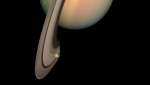 APOD: 2026 August 23 Б Cassini Approaches Saturn
23.08.2026
What would it look like to approach the grand planet Saturn? One doesn't have to just imagine -- the Cassini spacecraft did just this in 2004, recording thousands of images along the way, and hundreds of thousands more since entering orbit.
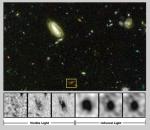 Pick a Galaxy Any Galaxy
17.01.2002
Pick a galaxy, any galaxy. In the top panel you can choose from a myriad of distant galaxies revealed in a deep Hubble Space Telescope image of a narrow slice of the cosmos toward the constellation Hercules.
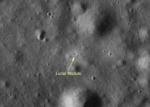 Lunar Module at Taurus Littrow
28.06.2002
Can the Hubble Space Telescope take a picture that shows the Apollo lunar modules on the Moon? With its 2.4 meter diameter mirror, the smallest object that the Hubble can resolve at the Moon's distance of around 400,000 kilometers is about 80 meters across.
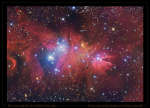 A Fox Fur, a Unicorn, and a Christmas Tree
6.04.2010
What do the following things have in common: a cone, the fur of a fox, and a Christmas tree? Answer: they all occur in the constellation of the unicorn (Monoceros). Pictured above...
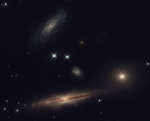 HCG 87: A Small Group of Galaxies
6.07.2010
Sometimes galaxies form groups. For example, our own Milky Way Galaxy is part of the Local Group of Galaxies. Small, compact groups, like Hickson Compact Group 87 (HCG 87) shown above, are interesting partly because they slowly self-destruct.
|
January February March April May June July August September |
|||||||||||||||||||||||||||||||||||||||||||||||||