
|
You entered: universe
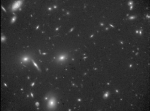 A Distant Cluster of Galaxies
14.01.1996
Every bright object in this 1994 photograph by the Hubble Space Telescope is a galaxy. Oddly - most of the objects are spiral galaxies. This rich cluster of galaxies, named CL 0939+4713, is almost half way across the visible universe.
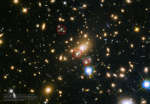 SN Refsdal: The First Predicted Supernova Image
21.12.2015
It's back. Never before has an observed supernova been predicted. The unique astronomical event occurred in the field of galaxy cluster MACS J1149.5+2223. Most bright spots in the featured image are galaxies in this cluster.
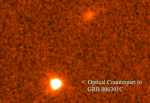 A GRB 000301C Symphony
14.03.2000
Telescopic instruments in Earth and space are still tracking a tremendous explosion that occurred across the universe. A nearly unprecedented symphony of international observations began abruptly on March 1 when Earth-orbiting RXTE, Sun-orbiting Ulysses, and asteroid-orbiting NEAR all detected a 10-second burst of high-frequency gamma radiation.
 Henrietta Leavitt Calibrates the Stars
3.09.2000
Humanity's understanding of the relative brightness and variability of stars was revolutionized by the work of Henrietta Swan Leavitt (1868-1921). Working at Harvard College Observatory, Leavitt precisely calibrated the photographic magnitudes of 47 stars to which all other stars could be compared.
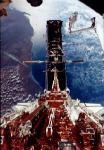 Orbiting Repairmen
28.01.1996
In December of 1993 astronauts Story Musgrave and Jeffrey Hoffman performed the orbiting repairmans' ballet 400 miles above the Earth. They are seen in this photo perched at the end of the Space Shuttle Endeavour's robotic arm making final repairs to the four story tall Hubble Space Telescope.
 Henrietta Leavitt Calibrates the Stars
27.10.1998
Humanity's understanding of the relative brightness and variability of stars was revolutionized by the work of Henrietta Swan Leavitt (1868-1921). Working at Harvard College Observatory, Leavitt precisely calibrated the photographic magnitudes of 47 stars to which all other stars could be compared.
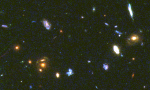 Distant Galaxies
7.09.1995
This Hubble Space Telescope image of a group of faint galaxies "far, far away" is a snap shot of the Universe when it was young. The bluish, irregularly shaped galaxies revealed in the image are up to eight billion light years away and seem to have commonly undergone galaxy collisions and bursts of star formation.
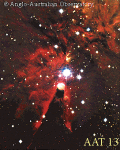 A Mysterious Cone Nebula
1.03.1996
Sometimes the simplest shapes are the hardest to explain. For example, the origin of the mysterious cone-shaped region located just below the center of the above picture remains a mystery. The dark region clearly contains much dust which blocks light from the emission nebula and open cluster NGC 2264 behind it.
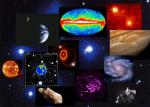 APOD is Six Years Old Today
16.06.2001
Welcome to the seventh year of Astronomy Picture of the Day (APOD). Editors Robert Nemiroff and Jerry Bonnell are extremely grateful for the continued large volume of gracious e-mail and APOD submissions (and also for the "occasional" critical note!). Today we would like to offer a very sincere thank you to all.
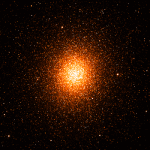 Millions of Stars in Omega Centauri
21.02.1996
Pictured above is the largest ball of stars in our Galaxy. About 10 million stars orbit the center of this globular cluster - named Omega Centauri - as this giant globular cluster orbits the center of our Galaxy.
|
January February March April May June July August September |
|||||||||||||||||||||||||||||||||||||||||||||||||