
|
You entered: universe
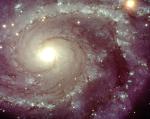 Spiral Galaxy NGC 2997 from VLT
4.08.2002
NGC 2997 is a grand design spiral galaxy. Its small nucleus and sprawling spiral arms give it a type Sc designation. NGC 2997, pictured above, is speeding away from us at about 1100 kilometers...
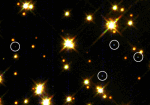 White Dwarfs Cool
10.09.1995
The circled stars in the above picture are from a class that is hard to see in the cosmos: white dwarfs. The entire photo covers a small region near the center of a globular cluster known as M4. Researchers using the Hubble Space Telescope discovered a large concentration of white dwarfs in M4.
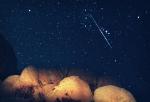 Bright Meteor, Dark Sky
20.08.1997
Has Orion the Hunter acquired a new weapon? If you turn your head sideways (counterclockwise) you might notice the familiar constellation of Orion, particularly the three consecutive bright stars that make up Orion's belt.
 Maria Mitchell Inspires a Generation
16.10.1999
"Do not look at stars as bright spots only - try to take in the vastness of the universe." On October 1, 1847 Maria Mitchell swept the sky with her telescope and discovered a comet (comet Mitchell 1847VI).
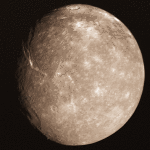 Uranus' Largest Moon: Titania
4.03.1996
Titania's tortured terrain is a mix of valleys and craters. NASA's interplanetary robot spacecraft Voyager 2 passed this moon of Uranus in 1986 and took the above photograph. The photograph was then transmitted back to earth by radio.
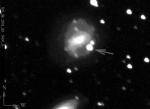 A Gamma Ray Burst Supernova
8.05.1998
Did a gamma-ray burst precede this supernova? This intriguing suggestion came to light yesterday with the discovery of an evolving supernova that is potentially coincident with the position of gamma-ray burst GRB 980425, which occurred just two weeks ago. If true, this would tie together the two most violent phenomena known in the universe.
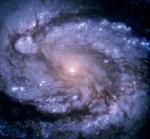 M100: A Grand Design
6.06.1998
Majestic on a truly cosmic scale, M100 is appropriately known as a Grand Design spiral galaxy. A large galaxy of over 100 billion or so stars with well defined spiral arms, it is similar to our own Milky Way.
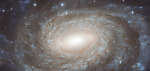 NGC 6384: Spiral Beyond the Stars
22.03.2011
The universe is filled with galaxies. But to see them astronomers must look out beyond the stars of our galaxy, the Milky Way. For example, consider this colorful telescopic view of spiral galaxy NGC 6384, about 80 million light-years away in the direction of the constellation Ophiuchus.
 APOD: 2023 June 5 Б In the Center of the Trifid Nebula
5.06.2023
What's happening at the center of the Trifid Nebula? Three prominent dust lanes that give the Trifid its name all come together. Mountains of opaque dust appear near the bottom, while other dark filaments of dust are visible threaded throughout the nebula.
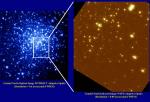 NGC 6934 from Gemini North
30.06.1999
What's going on near the center of globular cluster NGC 6934? The blur caused by the Earth's atmosphere has prevented astronomers from discerning individual stars in this unusual environment. Telescopes in space can help, but the new Gemini North telescope took the above picture from the ground.
|
January February March April May June July August September |
|||||||||||||||||||||||||||||||||||||||||||||||||