
|
You entered: universe
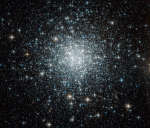 Globular Star Cluster NGC 6934
9.10.2010
Globlular star clusters roam the halo of our Milky Way Galaxy. Gravitationally bound, these spherical groupings of typically several hundred thousand stars are ancient, older than the stars of the galactic disk. In fact...
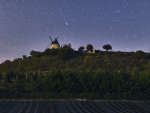 Comet Lovejoy over a Windmill
9.12.2013
Lovejoy continues to be an impressive camera comet. Pictured above, Comet C/2013 R1 (Lovejoy) was imaged above the windmill in Saint-Michel-l'Observatoire in southern France with a six-second exposure. In the foreground is a field of lavender.
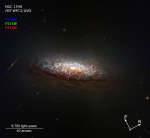 Hubble s NGC 1546
21.06.2024
Returning to science operations on June 14, the Hubble Space Telescope used its new pointing mode to capture this sharp image of spiral galaxy NGC 1546. A member of the Dorado galaxy group, the island universe lies a mere 50 million light-years away.
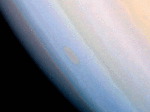 Saturn's Cloud Tops
17.03.1996
This close-up of the tops of Saturn's clouds was taken by the Voyager 1 robot spacecraft as it passed the giant planet in November 1980. Saturn's clouds are mostly composed of hydrogen and helium gas, but the small addition of other elements gives the clouds their colors.
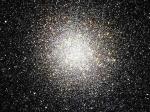 Globular Cluster M22 from CFHT
27.06.2005
The globular cluster M22, pictured above, contains over 100,000 stars. These stars formed together and are gravitationally bound. Stars orbit the center of the cluster, and the cluster orbits the center of our Galaxy. So far, about 140 globular clusters are known to exist in a roughly spherical halo around the Galactic center.
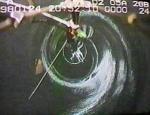 Ice Fishing for Cosmic Neutrinos
17.03.1999
In 1996, scientists melted a hole in the bottom of the world. In fact, several holes have been melted near the South Pole, and they are now being used as astronomical observatories. Astronomers with the Antarctic Muon and Neutrino Detector Array (AMANDA) lower into each vertical lake a string knotted with basketball-sized light detectors.
 APOD: 2024 May 30 Б A Lunar Corona over Paris
30.05.2024
Why does a cloudy moon sometimes appear colorful? The effect, called a lunar corona, is created by the quantum mechanical diffraction of light around individual, similarly-sized water droplets in an intervening but mostly-transparent cloud. Since light of different colors has different wavelengths, each color diffracts differently.
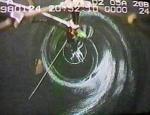 Ice Fishing for Cosmic Neutrinos
29.04.2001
Scientists are melting holes in the bottom of the world. In fact, several holes have been melted near the South Pole, and they are now being used as astronomical observatories. Astronomers with the Antarctic Muon and Neutrino Detector Array (AMANDA) lower into each vertical lake a string knotted with basketball-sized light detectors.
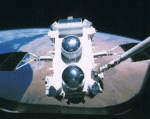 The Compton Gamma Ray Observatory
11.08.1995
The Compton Gamma Ray Observatory (CGRO) was the most massive instrument ever launched by a NASA Space Shuttle and continues to revolutionize gamma-ray astronomy. This orbiting observatory sees the sky in gamma-ray photons - light so blue humans can't see it.
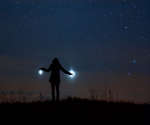 Jupiter and Venus from Earth
17.08.2014
It was visible around the world. The sunset conjunction of Jupiter and Venus in 2012 was visible almost no matter where you lived on Earth. Anyone on the planet with a clear western horizon at sunset could see them.
|
January February March April May June July August September |
|||||||||||||||||||||||||||||||||||||||||||||||||