
|
You entered: universe
 M100: A Grand Design Spiral Galaxy
25.12.2018
Majestic on a truly cosmic scale, M100 is appropriately known as a grand design spiral galaxy. It is a large galaxy of over 100 billion stars with well-defined spiral arms that is similar to our own Milky Way Galaxy.
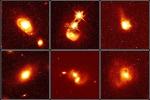 A Quasar Portrait Gallery
6.12.1997
QUASARs (QUASi-stellAR objects) lie near the edge of the observable Universe. Discovered in 1963, astronomers were astounded that such objects could be visible across billions of light-years, as this implies they must emit prodigious amounts of energy. Where does the energy come from?
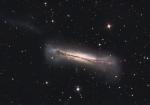 Sideways Galaxy NGC 3628
8.04.2005
Dark dust lanes cutting across the middle of this gorgeous island universe strongly hint that NGC 3628 is a spiral galaxy seen sideways. About 35 million light-years away in the northern springtime constellation...
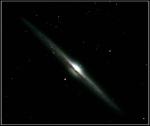 NGC 4565: Needle Galaxy
17.06.1999
Presenting a sleek needle-like profile the magnificent spiral galaxy NGC 4565 is viewed edge-on from planet Earth. Its core of stars bulges from the centre of a thin disk of spiral arms and dust. The core appears to be cut sharply by dust lanes to dramatic effect in this composite image.
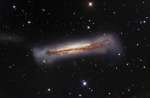 Sideways Galaxy NGC 3628
15.05.2008
Dark dust lanes cut across the middle of this gorgeous island universe, a strong hint that NGC 3628 is a spiral galaxy seen sideways. About 35 million light-years away in the northern springtime constellation...
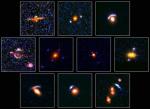 A Gallery of Gravitational Mirages
1.06.1999
The deeper you peer into the universe, the harder it is to see straight. The reason is that distant galaxies act as gravitational lenses, deflecting light that passes nearby. These deflections result in the distortion of background sources, and in some cases the creation of multiple images.
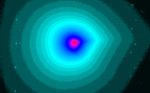 Near Comet Hyakutake's Nucleus
21.03.1996
This March 19th false-color picture of Comet Hyakutake from one of the most sophisticated ground based telescopes captures the area surrounding the comet's nucleus. A comet's nucleus - not directly visible here - is a solid dirty iceball probably no more than 10 kilometers across.
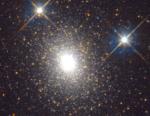 A Giant Globular Cluster in M31
17.10.1998
This cluster of stars, known as G1, is the brightest globular cluster in the whole Local Group of galaxies. Also called Mayall II, it orbits the center of the largest nearby galaxy: M31. G1 contains over 300,000 stars and is almost as old as the entire universe.
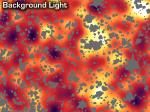 Light from the First Stars
2.01.2007
What were the first stars like? No one is yet sure. Our Sun is not a first-generation star. It is not even second generation. The first stars to appear in the universe likely came and went about 13 billion years ago.
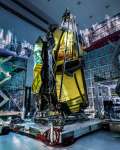 JWST: Ghosts and Mirrors
18.03.2017
Ghosts aren't actually hovering over the James Webb Space Telescope. But the lights are out as it stands with gold tinted mirror segments and support structures folded in Goddard Space Flight Center's Spacecraft Systems Development and Integration Facility clean room.
|
January February March April May June July August September |
|||||||||||||||||||||||||||||||||||||||||||||||||