
|
You entered: universe
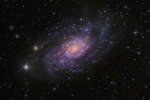 NGC 2403 in Camelopardalis
26.03.2015
Magnificent island universe NGC 2403 stands within the boundaries of the long-necked constellation Camelopardalis. Some 10 million light-years distant and about 50,000 light-years across, the spiral galaxy also seems to have more than its fair share of giant star forming HII regions, marked by the telltale reddish glow of atomic hydrogen gas.
 Higgs Boson Explained by Cartoon
1.05.2012
What is all this fuss about the Higgs boson? The physics community is abuzz that a fundamental particle expected by the largely successful Standard Model of particle physics may be soon be found by the huge Large Hadron Collider (LHC) at CERN in Europe.
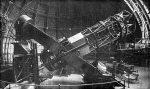 The Hooker Telescope on Mt. Wilson
1.07.1995
In the 1920s, pictures from the Hooker Telescope on Mt. Wilson fundamentally changed our understanding of the cosmos. Astronomer Edwin Hubble, using photographs he took with this telescope, demonstrated that the objects his contemporaries called "spiral nebulae" were actually huge systems of stars - spiral galaxies, similar to our own Milky Way galaxy but incredibly distant.
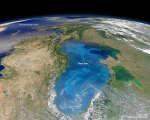 A White Battle in the Black Sea
23.04.2017
Trillions have died in the Earth's seas. Calcified shields of the dead already make up the white cliffs of Dover. The battle between ball-shaped light-colored single-celled plants -- phytoplankton called coccolithophores -- and even smaller, diamond-shaped viruses dubbed coccolithoviruses -- has raged for tens of millions of years.
 Saturn in Infrared from Cassini
23.07.2022
Many details of Saturn appear clearly in infrared light. Bands of clouds show great structure, including long stretching storms. Also quite striking in infrared is the unusual hexagonal cloud pattern surrounding Saturn's North Pole. Each side of the dark hexagon spans roughly the width of our Earth.
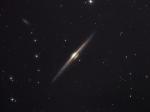 NGC 4565: Galaxy on the Edge
8.07.2005
Magnificent spiral galaxy NGC 4565 is viewed edge-on from planet Earth. Also known as the Needle Galaxy for its narrow profile, bright NGC 4565 is a stop on many telescopic tours of the northern sky as it lies in the faint but well-groomed constellation Coma Berenices.
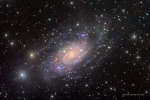 NGC 2403 in Camelopardalis
18.02.2016
Magnificent island universe NGC 2403 stands within the boundaries of the long-necked constellation Camelopardalis. Some 10 million light-years distant and about 50,000 light-years across, the spiral galaxy also seems to have more than its fair share of giant star forming HII regions, marked by the telltale reddish glow of atomic hydrogen gas.
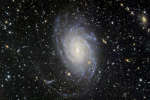 Spiral Galaxy NGC 6744
25.05.2017
Big, beautiful spiral galaxy NGC 6744 is nearly 175,000 light-years across, larger than our own Milky Way. It lies some 30 million light-years distant in the southern constellation Pavo appearing as a faint, extended object in small telescopes. We see the disk of the nearby island universe tilted towards our line of sight.
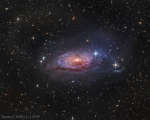 Messier 63: The Sunflower Galaxy
5.06.2019
A bright spiral galaxy of the northern sky, Messier 63 is about 25 million light-years distant in the loyal constellation Canes Venatici. Also cataloged as NGC 5055, the majestic island universe is nearly 100,000 light-years across. That's about the size of our own Milky Way Galaxy.
 The Mountains of NGC 2174
15.01.2021
This fantastic skyscape lies near the edge of NGC 2174 a star forming region about 6,400 light-years away in the nebula-rich constellation of Orion. It follows mountainous clouds of gas and dust carved...
|
January February March April May June July August |
||||||||||||||||||||||||||||||||||||||||||||||||||||||||