
|
You entered: universe
 VLT: A New Largest Optical Telescope
1.09.1996
What is the largest telescope in the world? In the optical, this title was long held by the Hale 200-inch, and is presently held by the Keck telescopes in Hawaii. But an even larger optical telescope is being built.
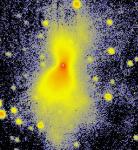 Cold Wind From The Boomerang Nebula
15.10.1997
A cold wind blows from the central star of the Boomerang Nebula. Seen here in a false color image of dust reflected starlight, the nebula lies about 5,000 light-years away. The boomerang shaped...
 Space Walz
11.02.1997
Astronaut Carl Walz waves at his colleagues from the aft end of the Space Shuttle Discovery's payload bay - during a 1993 spacewalk to evaluate tools, tethers, and a foot restraint slated for use in the first Hubble Space Telescope servicing mission.
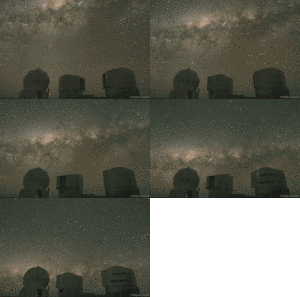 The Milky Way Over Paranal
23.01.2007
It's not the sky that's falling. More accurately, the Earth is rising. The Earth's rotation gives a continually changing view to all Earth observers, including those measuring the universe at the Paranal Observatory.
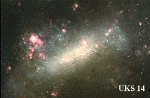 The Large Cloud Of Magellan (LMC)
24.01.1998
Ferdinand Magellan and his crew had plenty of time to study the southern sky during their famous voyage around the world. As a result, two fuzzy cloud-like objects, not visible to northern hemisphere dwellers, are now known as the Clouds of Magellan.
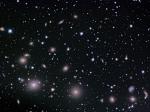 The Perseus Cluster of Galaxies
25.10.2004
Here is one of the largest objects that anyone will ever see on the sky. Each of the fuzzy blobs in the above picture is a galaxy, together making up the Perseus Cluster, one of the closest clusters of galaxies.
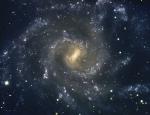 The Arms of NGC 7424
16.12.2004
The grand, winding arms are almost mesmerizing in this face-on view of NGC 7424, a spiral galaxy with a prominent central bar. About 40 million light-years distant in the headlong constellation Grus, this island universe is also about 100,000 light-years across making it remarkably similar to our own Milky Way.
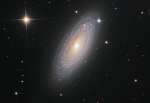 Spiral Galaxy NGC 2841
29.03.2008
Some 50 million light-years distant, spiral galaxy NGC 2841 can be found in the northern constellation of Ursa Major. This sharp view of the gorgeous island universe shows off a striking yellow nucleus and galactic disk with tightly wound spiral arms.
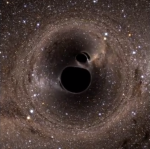 When Black Holes Collide
11.04.2021
What happens when two black holes collide? This extreme scenario occurs in the centers of many merging galaxies and multiple star systems. The featured video shows a computer animation of the final stages of such a merger, while highlighting the gravitational lensing effects that would appear on a background starfield.
 APOD: 2025 July 31 Б Supernova 2025rbs in NGC 7331
31.07.2025
A long time ago in a galaxy 50 million light-years away, a star exploded. Light from that supernova was first detected by telescopes on planet Earth on July 14th though, and the extragalactic transient is now known to astronomers as supernova 2025rbs.
|
January February March April May June July August September |
|||||||||||||||||||||||||||||||||||||||||||||||||