
|
You entered: universe
 Our Story in One Minute
26.11.2017
Do you have a minute -- to see the entire backstory of human existence? This thrilling video culls together multiple teasing video snippets in an attempt to succinctly summarize our history. And sets it to music.
 The Millennium that Defined Earth
31.12.2000
When the second millennium began, people generally knew that the Earth was round, but few saw much of it beyond their local village. As the millennium progressed, humans mapped the continents, circumnavigated the globe, and determined the composition of the Earth.
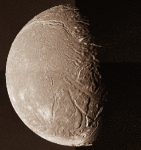 Uranus' Moon Ariel: Valley World
3.03.1996
What formed Ariel's valleys? This question presented itself when Voyager 2 passed this satellite of Uranus in January 1986. Speculation includes that heating caused by the ancient tides of Uranus caused moonquakes and massive shifting of the moon's surface.
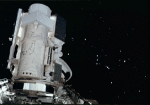 Astro 1 In Orbit
4.05.1996
In December of 1990, the Space Shuttle Columbia carried an array of astronomical telescopes high above the Earth's obscuring atmosphere to observe the Universe at ultraviolet and x-ray wavelengths. The telescopes, known...
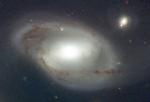 The Galaxy and the Quasar
7.10.2002
Is the galaxy in the center connected to the quasar on the upper right? Disagreements about systems like this have raged for decades and have been used to challenge the foundations of modern cosmology.
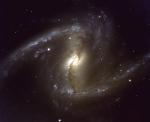 NGC 1365: A Nearby Barred Spiral Galaxy
24.06.1999
Many spiral galaxies have bars across their centers. Even our own Milky Way Galaxy is thought to have a bar, but perhaps not so prominent as the one in NGC 1365, shown above. The persistence and motion of the bar imply relatively massive spiral arms.
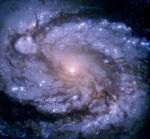 M100: A Grand Design
1.06.1997
Majestic on a truly cosmic scale, M100 is appropriately known as a Grand Design spiral galaxy. A large galaxy of over 100 billion or so stars with well defined spiral arms, it is similar to our own Milky Way.
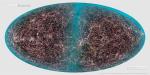 The 2MASS Galaxy Sky
26.06.2005
Are the nearest galaxies distributed randomly? A plot of over one million of the brightest "extended sources" detected by the Two Micron All Sky Survey (2MASS) shows that they are not. The vast majority of these infrared extended sources are galaxies.
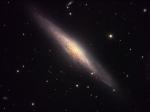 NGC 2683: Spiral Edge On
27.11.2004
This gorgeous island universe, cataloged as NGC 2683, lies a mere 16 million light-years distant in the northern constellation Lynx. A spiral galaxy comparable to our own Milky Way, NGC 2683 is seen nearly edge-on in this cosmic vista, with more distant galaxies scattered in the background.
 Astro 1 In Orbit
3.12.2005
Fifteen years ago, in December of 1990, the Space Shuttle Orbiter Columbia carried an array of astronomical telescopes high above the Earth's obscuring atmosphere to explore the Universe at ultraviolet and x-ray wavelengths.
|
January February March April May June July August September |
|||||||||||||||||||||||||||||||||||||||||||||||||