
|
You entered: universe
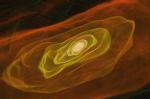 Zooming in on the First Stars
10.06.2003
What became of the first stars? No known stars appear to be composed of truly primordial gas -- all of the stars around us have too many heavy elements. Our own Sun is thought to be a third generation star, with many second-generation stars seen in globular clusters.
 UHZ1: Distant Galaxy and Black Hole
10.11.2023
Dominated by dark matter, massive cluster of galaxies Abell 2744 is known to some as Pandora's Cluster. It lies 3.5 billion light-years away toward the constellation Sculptor. Using the galaxy cluster's enormous...
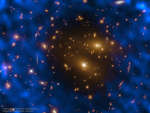 Galaxy Cluster Gas Creates Hole in Microwave Background
10.04.2017
Why would this cluster of galaxy punch a hole in the cosmic microwave background (CMB)? First, the famous CMB was created by cooling gas in the early universe and flies right through most gas and dust in the universe. It is all around us.
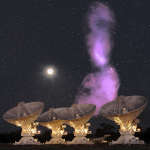 Centaurus Radio Jets Rising
13.04.2011
What if you could see the huge radio jets of Centaurus A rising? The Cen A radio jets are not only over a million light years long, they occupy an angular area over 200 times greater than the full Moon in Earth's sky.
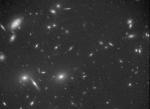 A Distant Cluster of Galaxies
7.12.1997
In this 1994 Hubble Space Telescope photograph, every bright object is a galaxy. Oddly - most of them are spiral galaxies. This rich cluster of galaxies, named CL 0939+4713, is almost half way across the visible universe.
 Fermi's First Light
28.08.2008
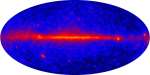
Launched on June 11 to explore the universe at extreme energies, the Gamma-ray Large Area Space Telescope has been officially renamed the Fermi Gamma-ray Space Telescope, in honor of Nobel Laureate Enrico Fermi (1901-1954), pioneer in high-energy physics.
 Simulation: A Disk Galaxy Forms
17.07.2012
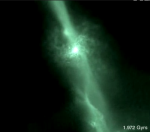
How do galaxies like our Milky Way form? Since our universe moves too slowly to watch, faster-moving computer simulations are created to help find out. Green depicts (mostly) hydrogen gas in the above movie, while time is shown in billions of years since the Big Bang on the lower right.
 An ALMA Telescope Array Time Lapse
26.05.2014
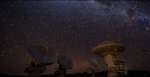
It is the most expensive and complex ground-based astronomy project ever -- what will it see tonight? The Atacama Large Millimeter Array (ALMA) project consists of 66 dishes, many the size of a small house, situated in the high altitude Atacama Desert in Northern Chile.
 Distant Galaxies
22.06.1997
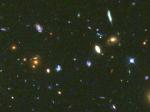
This Hubble Space Telescope image of a group of faint galaxies "far, far away" is a snap shot of the Universe when it was young. The bluish, irregularly shaped galaxies revealed in the image are up to eight billion light years away and seem to have commonly undergone galaxy collisions and bursts of star formation.
 A GRB 000301C Symphony
3.06.2001
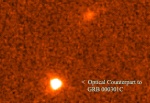
Last March, telescopic instruments in Earth and space tracked a tremendous explosion that occurred across the universe. A nearly unprecedented symphony of international observations began abruptly on 2000 March 1 when Earth-orbiting RXTE, Sun-orbiting Ulysses, and asteroid-orbiting NEAR all detected a 10-second burst of high-frequency gamma radiation. Within 48 hours astronomers
|
January February March April May June July August September |
|||||||||||||||||||||||||||||||||||||||||||||||||