
|
You entered: universe
 Albert Einstein s Miraculous Year
22.04.2005
In 1905 Albert Einstein had a miraculous year. One hundred years ago, he wrote four papers which revolutionized our understanding of the Universe. The papers outlined; the idea that light could behave...
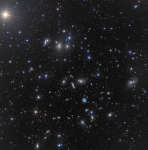 The Hercules Cluster of Galaxies
25.06.2014
These are galaxies of the Hercules Cluster, an archipelago of island universes a mere 500 million light-years away. Also known as Abell 2151, this cluster is loaded with gas and dust rich, star-forming spiral galaxies but has relatively few elliptical galaxies, which lack gas and dust and the associated newborn stars.
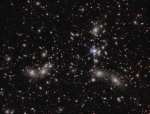 APOD: 2025 October 3 Б Pandora's Cluster of Galaxies
3.10.2025
This deep field mosaicked image presents a stunning view of galaxy cluster Abell 2744 recorded by the James Webb Space Telescope's NIRCam. Also dubbed Pandora's Cluster, Abell 2744 itself appears to be a ponderous merger of three different massive galaxy clusters. It lies some 3.5 billion light-years away, toward the constellation Sculptor.
 Quantum Gravity Claimed Detected on Earth
22.01.2002
Does gravity come in chucks? A theory known as Quantum Mechanics tells us about how the universe works on the smallest scales, while Einstein's General Theory of Relativity tells us about how gravity and the universe works on the largest scales. So far, no complete theory has been able to encompass them both.
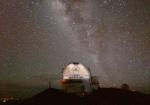 A Gemini Sky
9.09.2003
Where will Gemini take us tonight? It is dusk and Gemini North, one of the largest telescopes on planet Earth, prepares to peer into the distant universe. Gemini's flexible 8.1-mirror has taken...
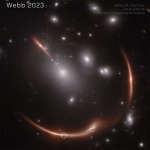 APOD: 2025 October 7 Б SN Encore: A Second Supernova Seen Several Times
7.10.2025
Now a second supernova in this same galaxy is repeating. The cause is the gravitational lens effect of a massive foreground cluster of galaxies (MACS J0138) -- it creates multiple images of a perfectly aligned background galaxy (MRG-M0138). What's particularly interesting is that this background galaxy has young stars that keep blowing up.
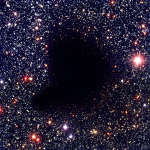 APOD: 2023 January 29 Б Barnard 68: Dark Molecular Cloud
29.01.2023
Where did all the stars go? What used to be considered a hole in the sky is now known to astronomers as a dark molecular cloud. Here, a high concentration of dust and molecular gas absorb practically all the visible light emitted from background stars.
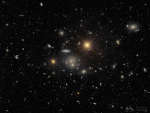 The Hydra Cluster of Galaxies
16.02.2023
Once upon a midnight dreary, while I pondered weak and weary, O'er volumes of astronomy and forgotten lore, I stumbled upon this snapshot, cosmic and eerie, A sight that filled my heart with awe and more.
 Andromeda Nebula: Var!
6.04.1996
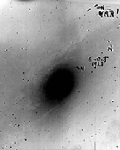
In the 1920s, using photographic plates made with the Mt. Wilson Observatory's 100 inch telescope, Edwin Hubble determined the distance to the Andromeda Nebula - decisively demonstrating the existence of other galaxies far beyond the Milky Way.
 NGC 1569: Heavy Elements from a Small Galaxy
25.07.2002
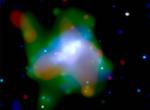
For astronomers, elements other than hydrogen and helium are sometimes considered to be simply "heavy elements". It's understandable really, because even lumped all together heavy elements make up an exceedingly small fraction of the Universe. Still, heavy elements can profoundly influence galaxy and star formation ... not to mention the formation of planets and people.
|
January February March April May June July August September |
|||||||||||||||||||||||||||||||||||||||||||||||||