
|
You entered: universe
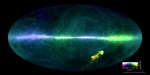 HI4PI: The Hydrogen Sky
24.10.2016
Where are the Milky Way's gas clouds and where are they going? To help answer this question, a new highest-resolution map of the sky in the universe's most abundant gas -- hydrogen -- has been completed and recently released, along with its underlying data.
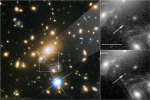 Fortuitous Flash Candidate for the Farthest Star Yet Seen
11.04.2018
Was this flash the farthest star yet seen? An unexpected flash of light noticed fortuitously on Hubble Space Telescope images may prove to be not only an unusual gravitational lensing event but also an image of a normal star 100 times farther away than any star previously imaged individually.
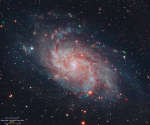 APOD: 2026 September 18 Б Messier 33: The Triangulum Galaxy
18.09.2026
The small, northern constellation Triangulum harbors this magnificent face-on spiral galaxy, Messier 33. Its popular names include the Pinwheel Galaxy or just the Triangulum Galaxy. M33 is over 50,000 light-years in diameter, third largest in the Local Group of galaxies after the Andromeda Galaxy (M31), and our own Milky Way.
 APOD: 2024 July 30 Б Arp 142: Interacting Galaxies from Webb
30.07.2024
To some, it looks like a penguin. But to people who study the universe, it is an interesting example of two big galaxies interacting. Just a few hundred million years ago, the upper NGC 2936 was likely a normal spiral galaxy: spinning, creating stars, and minding its own business.
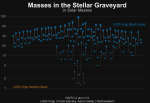 Fifty Gravitational Wave Events Illustrated
4.11.2020
Over fifty gravitational wave events have now been detected. These events mark the distant, violent collisions of two black holes, a black hole and a neutron star, or two neutron stars. Most of the 50 events were detected in 2019 by the LIGO gravitational wave detectors in the USA and the VIRGO detector in Europe.
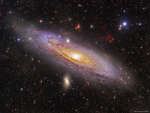 M31: The Andromeda Galaxy
9.09.2019
How far can you see? The most distant object easily visible to the unaided eye is M31, the great Andromeda Galaxy, over two million light-years away. Without a telescope, even this immense spiral galaxy appears as an unremarkable, faint, nebulous cloud in the constellation Andromeda.
 APOD: 2024 July 1 Б Time Spiral
1.07.2024
What's happened since the universe started? The time spiral shown here features a few notable highlights. At the spiral's center is the Big Bang, the place where time, as we know it, began about 13.8 billion years ago.
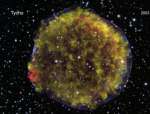 Tychos Supernova Remnant Expands
1.06.2016
What star created this huge expanding puffball? Featured here is the first expansion movie ever created for Tycho's supernova remnant, the result of a stellar explosion first recorded over 400 years ago by the famous astronomer Tycho Brahe.
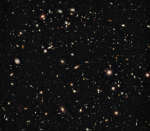 HUDF Infrared: Dawn of the Galaxies
9.12.2009
When did galaxies form? To help find out, the deepest near-infrared image of the sky ever has been taken of the same field as the optical-light Hubble Ultra Deep Field (HUDF) in 2004. The new image was taken this summer by the newly installed Wide Field Camera 3 on the refurbished Hubble Space Telescope.
 Powers of Ten
1.02.2011
How different does the universe look on small, medium, and large scales? The most famous short science film of its generation gives breathtaking comparisons. That film, Powers of Ten, originally created in the 1960s, has now been officially posted to YouTube and embedded above.
|
January February March April May June July August September |
|||||||||||||||||||||||||||||||||||||||||||||||||