
|
You entered: Sun
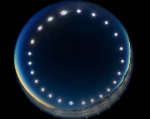 Eclipse on a Polar Day
9.12.2021
During polar day, in Arctic and Antarctic summer, the Sun stays above the horizon for periods of 24 hours or more. Recorded on December 4, this fisheye timelapse image tracks the Sun in multiple frames as it completes a circle in the summer sky above Union Glacier, Antarctica.
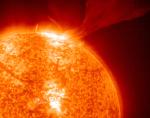 A Solar Prominence Erupts
24.09.2001
Our Sun is still very active. Last year, our Sun went though Solar Maximum, the time in its 11-year cycle where the most sunspots and explosive activities occur. Sunspots, the Solar Cycle, and solar prominences are all caused by the Sun's changing magnetic field.
 The Eclipse Tree
24.12.2000
If you look closely at the shadow of this tree, you will see something quite unusual: it is composed of hundreds of images of a partially eclipsed Sun. Early today, trees across North America will be casting similar shadows as a partial eclipse of the Sun takes place.
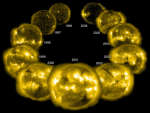 A Complete Solar Cycle from SOHO
2.12.2007
Every eleven years, our Sun goes through a solar cycle. A complete solar cycle has now been imaged by the sun-orbiting SOHO spacecraft, celebrating the 12th anniversary of its launch yesterday. A solar cycle...
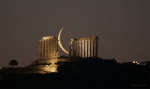 APOD: 2023 February 28 Б Crescent Moon Beyond Greek Temple
27.02.2023
Why is a thin crescent moon never seen far from a horizon? Because the only geometry that gives a thin crescent lunar phase occurs when the Moon appears close to the Sun in the sky.
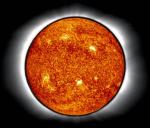 Solar Eclipse: A Composite View
26.02.1998
Yesterday, the Moon's shadow reached out and touched the Earth, treating a large portion of the Western Hemisphere to an Eclipse of the Sun. This composite image combines pictures of the Sun made from both Earth and space.
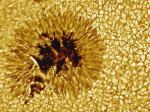 A Sunspot Up Close
5.11.2005
Why would a small part of the Sun appear slightly dark? Visible above is a close-up picture of a sunspot, a depression on the Sun's face that is slightly cooler and less luminous than the rest of the Sun.
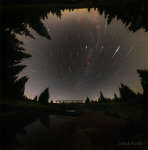 APOD: 2026 August 18 Б Perseids from Perseus
17.08.2026
This was a good year for the Perseids meteor shower. A key reason was the Moon was absent from lighting up Earth's night sky so that more meteors were visible than usual. Where was the Moon? It was busy visiting the Sun.
 Eclipse over the Temple of Poseidon
17.01.2010
What's happened to the Sun? The Moon moved to partly block the Sun for a few minutes last week as a partial solar eclipse became momentarily visible across part of planet Earth.
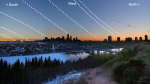 Equinox in the Sky
21.09.2020
Does the Sun set in the same direction every day? No, the direction of sunset depends on the time of the year. Although the Sun always sets approximately toward the west, on an equinox like today the Sun sets directly toward the west.
|
January February March April May June July August September |
|||||||||||||||||||||||||||||||||||||||||||||||||