
|
You entered: Sun
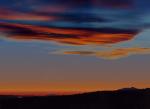 Mercury on the Horizon
20.03.2000
Have you ever seen the planet Mercury? Because Mercury orbits so close to the Sun, it is never seen far from the Sun, and so is only visible near sunrise or sunset. If trailing the Sun, Mercury will be visible for several minutes before it follows the Sun behind the Earth.
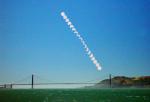 A Partial Eclipse Over the Golden Gate Bridge
12.06.2002
Part of the Sun disappeared behind the Moon earlier this week. Previously, the waning Moon was best visible from all places on Earth during the early morning hours because it trailed the Sun. As the Moon orbited the Earth, however, it caught up to the Sun and passed it on the sky.
 Solar Magnetic Bananas
29.06.1998
Is that our Sun? The unusual banana-shaped loops shown above are actually part of a computer-generated snap-shot of our Sun's magnetic field. This animated frame was constructed using data from the ground-based U.S. Solar Vector Magnetograph and the space-based Japanese X-Ray Telescope Yohkoh.
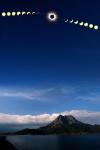 A Total Solar Eclipse over Turkey
4.04.2006
Some views of last week's total eclipse of the Sun were better than others. One spectacular view occurred over Adrasan (near Antalya), Turkey and was captured there by industrious astrophotographer Stefan Seip. The above digital mosaic caught the Moon in several stages as it moved between the Earth and the Sun.
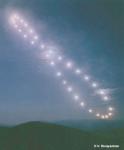 Analemma
9.07.2002
If you took a picture of the Sun at the same time each day, would it remain in the same position? The answer is no, and the shape traced out by the Sun over the course of a year is called an analemma.
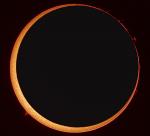 An Annular Solar Eclipse at High Resolution
5.10.2005
On Monday, part of the Sun went missing. The missing piece was no cause for concern -- the Moon was only momentarily in the way. The event was not a total eclipse of the Sun for any Earth-bound sky enthusiast but rather, at best, an annular eclipse, where the Moon blocked most of the Sun.
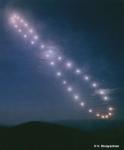 Analemma over the Ukraine
17.06.2007
If you took a picture of the Sun at the same time each day, would it remain in the same position? The answer is no, and the shape traced out by the Sun over the course of a year is called an analemma.
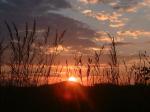 Zimbabwe Sunset
21.06.2002
Today's scheduled geocentric astronomical event is the Solstice, with the Sun reaching its northernmost declination at 13 hours 24 minutes Universal Time. For denizens of planet Earth this Solstice marks the begining of Summer in the northern hemisphere and Winter in the south.
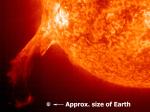 An Erupting Solar Prominence from SOHO
7.08.2006
Our Sun is still very active. In the year 2000, our Sun went though Solar Maximum, the time in its 11-year cycle where the most sunspots and explosive activities occur. Sunspots, the Solar Cycle, and solar prominences are all caused by the Sun's changing magnetic field.
 A Partial Solar Eclipse over Texas
13.09.2015
It was a typical Texas sunset except that most of the Sun was missing. The location of the missing piece of the Sun was not a mystery -- it was behind the Moon. Featured here...
|
January February March April May June July August September |
|||||||||||||||||||||||||||||||||||||||||||||||||