
|
You entered: Sun
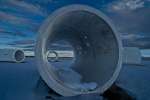 Through a Sun Tunnel
22.12.2011
Today the Sun stands still at 05:30 UT. Halting its steady march toward southern declinations and begining its annual journey north, the event is known as a solstice. In the northern hemisphere December's solstice marks the astronomical start of winter.
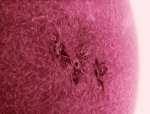 Angry Sun Erupting
14.03.2012
It's one of the baddest sunspot regions in years. Active Region 1429 may not only look, to some, like an angry bird -- it has thrown off some of the most powerful flares and coronal mass ejections of the current solar cycle.
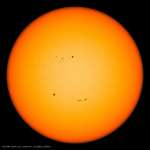 Live: Watching for Venus to Cross the Sun
5.06.2012
Today Venus moves in front of the Sun. One way to follow this rare event is to actively reload the above live image of the Sun during the right time interval and look for an unusual circular dark dot. The smaller sprawling dark areas are sunspots. The circular dot is the planet Venus.
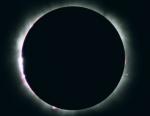 Total Eclipse of the Active Sun
20.06.2001
A total eclipse of the Sun is that special geocentric celestial event where the Moon passes exactly in front of the solar disk. During a fleeting few minutes of totality, fortunate earthdwellers located within...
 APOD: 2023 November 19 Б Space Station, Solar Prominences, Sun
18.11.2023
That's no sunspot. It's the International Space Station (ISS) caught passing in front of the Sun. Sunspots, individually, have a dark central umbra, a lighter surrounding penumbra, and no Dragon capsules attached.
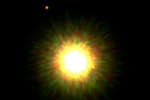 Companion of a Young, Sun-like Star Confirmed
4.07.2010
The first direct image of an extrasolar planet orbiting a star similar to our Sun has been confirmed. Located just 500 light-years away toward the constellation Scorpius, the parent star, cataloged as 1RXS J160929.1-210524, is only slightly less massive and a little cooler than the Sun.
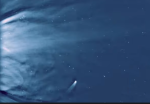 APOD: 2025 March 31 Б Parker: The Solar System from Near the Sun
30.03.2025
If you watch long enough, a comet will appear. Before then, you will see our Solar System from inside the orbit of Mercury as recorded by NASA's Parker Solar Probe looping around the Sun.
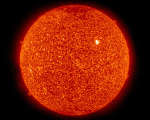 Active Region 1002 on an Unusually Quiet Sun
24.09.2008
Why has the Sun been so quiet recently? No one is sure. Our Sun has shown few active regions -- that house even fewer associated sunspots -- for over a year now, and such a period of relative calm is quite unusual.
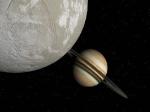 Worlds of a Distant Sun: 47 Ursae Majoris b
5.10.1997
In the last few years, observational astronomy has given humanity evidence of the existence of worlds beyond the solar system. Solar-type stars are now inferred to harbor planets of approximately Jupiter mass - some residing in temperature zones which could conceivably support liquid water and therefore life!
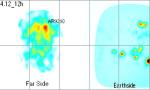 Far Side of the Sun
3.05.2001
You may think it's impossible to see through the Sun, but maps of the Sun's far side are now made routinely by instruments on board the sun-staring SOHO spacecraft. This is one such map from April 12.
|
January February March April May June July August September |
|||||||||||||||||||||||||||||||||||||||||||||||||