
|
You entered: Sun
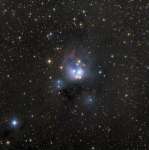 Young Suns of NGC 7129
4.09.2010
Young suns still lie within dusty NGC 7129, some 3,000 light-years away toward the royal constellation Cepheus. While these stars are at a relatively tender age, only a few million years old, it is likely that our own Sun formed in a similar stellar nursery some five billion years ago.
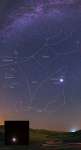 Opposite the Sun
18.09.2010
Chances are the brightest star you've seen lately is actually planet Jupiter. Jupiter rules the sky in this labeled view of a starry September night from the Alborz mountains in Iran, complete with the trail of a red flashlight illuminating the mountain road.
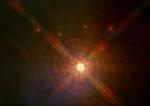 Young Suns
18.02.2000
The star cataloged as NGC2264 IRS is normally hidden from the inquiring gaze of optical telescopes. It resides in the midst of the obscuring gas and dust of a nearby star forming region popularly known as the Cone Nebula.
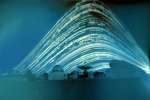 Days in the Sun
21.01.2012
From solstice to solstice, this six month long exposure compresses time from the 21st of June till the 21st of December, 2011, into a single point of view. Dubbed a solargraph, the unconventional picture was recorded with a pinhole camera made from a drink can lined with a piece of photographic paper.
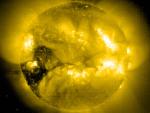 Coronal Holes on the Sun
17.03.2003
The ominous, dark shapes haunting the left side of the Sun are coronal holes -- low density regions extending above the surface where the solar magnetic field opens freely into interplanetary space. Studied extensively from...
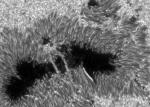 Light Bridges on the Sun
22.05.2000
Bridges the length of a planet can form on the Sun in a matter of hours. Known as light bridges, these structures may form as large sunspot groups decay. Above, one of the sharpest photographs of the Sun ever taken shows two such light bridges that appeared late last month.
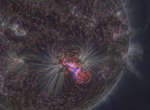 Solar Flare from a Sharper Sun
21.11.2014
Solar active region AR2192 was the largest recorded sunspot group of the last 24 years. Before rotating off the Earth-facing side of the Sun at the end of October, it produced a whopping six energetic X-class flares.
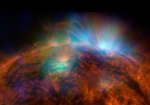 The Sun in X rays from NuSTAR
28.12.2014
Why are the regions above sunspots so hot? Sunspots themselves are a bit cooler than the surrounding solar surface because the magnetic fields that create them reduce convective heating. It is therefore unusual that regions overhead -- even much higher up in the Sun's corona -- can be hundreds of times hotter.
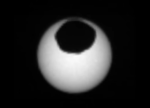 Martian Moon Phobos Crosses the Sun
9.04.2019
What's that passing in front of the Sun? It looks like a moon, but it can't be Earth's Moon, because it isn't round. It's the Martian moon Phobos. The featured video was taken from the surface of Mars late last month by the Curiosity rover.
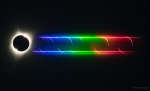 The Flash Spectrum of the Sun
6.09.2017
In clear Madras, Oregon skies, this colorful eclipse composite captured the elusive chromospheric or flash spectrum of the Sun. Only three exposures, made on August 21 with telephoto lens and diffraction grating, are aligned in the frame.
|
January February March April May June July August September |
|||||||||||||||||||||||||||||||||||||||||||||||||