
|
You entered: Sun
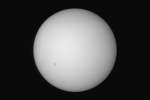 The International Space Station Transits the Sun
30.07.2008
That's no sunspot. It's the International Space Station (ISS) caught by chance passing in front of the Sun. Sunspots, individually, have a dark central umbra, a lighter surrounding penumbra, and no solar panels.
 APOD: 2025 December 7 Б The Sun and Its Missing Colors
7.12.2025
It is still not known why the Sun's light is missing some colors. Here are all the visible colors of the Sun, produced by passing the Sun's light through a prism-like device.
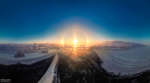 Sun Halo at Sixty three Degrees North
21.12.2022
Happy Solstice! Today is the December solstice, marking an astronomical beginning of summer in the southern hemisphere and winter in the north. On its yearly trek through planet Earth's skies, at this solstice the Sun reaches its southern most declination, 23.5 degrees south, at 21:48 UTC.
 APOD: 2025 May 21 Б International Space Station Crosses the Sun
21.05.2025
Typically, the International Space Station is visible only at night. Slowly drifting across the night sky as it orbits the Earth, the International Space Station (ISS) can be seen as a bright spot about once a month from many locations.
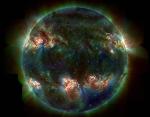 Dark Sun Sizzling
10.07.2006
Is this our Sun? Yes. Even on a normal day, our Sun is sizzling ball of seething hot gas. Unpredictably, regions of strong and tangled magnetic fields arise, causing sunspots and bright active regions. The Sun's surface bubbles as hot hydrogen gas streams along looping magnetic fields.
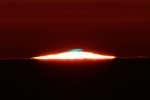 A Green Flash from the Sun
4.01.2011
Many think it is just a myth. Others think it is true but its cause isn't known. Adventurers pride themselves on having seen it. It's a green flash from the Sun. The truth is the green flash does exist and its cause is well understood.
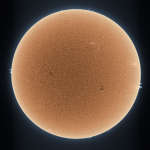 Orange Sun Simmering
9.06.2010
Even a quiet Sun can be a busy place. And over the deep Solar Minimum of the past few years, our Sun has been unusually quiet. The above image, taken last week...
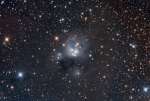 Young Suns of NGC 7129
3.10.2008
Young suns still lie within dusty NGC 7129, some 3,000 light-years away toward the royal constellation Cepheus. While these stars are at a relatively tender age, only about a million years old, it is likely that our own Sun formed in a similar stellar nursery some five billion years ago.
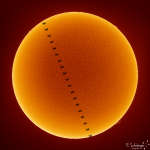 The Space Station Crosses a Spotless Sun
28.10.2019
Typically, the International Space Station is visible only at night. Slowly drifting across the night sky as it orbits the Earth, the International Space Station (ISS) can be seen as a bright spot about once a month from many locations.
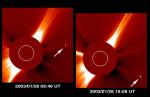 Comet Kudo-Fujikawa: Days in the Sun
30.01.2003
Cruising through the inner Solar System, new Comet Kudo-Fujikawa reached perihelion, its closest approach to the Sun, yesterday, January 29. Passing within 28.4 million kilometers of the Sun, this comet came much closer than innermost planet Mercury basking only 57.9 million kilometers from our parent star.
|
January February March April May June July August September |
|||||||||||||||||||||||||||||||||||||||||||||||||