
|
You entered: Sun
 Driving to the Sun
27.07.1996
How long would it take to drive to the Sun? Brittany, age 7, and D.J., age 12, ponder this question over dinner one evening. James, also age 7, suggests taking a really fast racing car while Christopher, age 4, eagerly agrees.
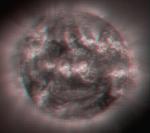 Stereo Sun
7.04.2001
This week's stereo offering features the now famous Active Region 9393, the largest sunspot group in the last 10 years. Viewed with red/blue glasses, the stereo pair of images merges into one 3D representation of the Sun with AR9393 above and right of center.
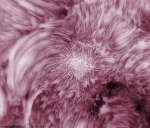 Fibrils Flower on the Sun
16.02.2015
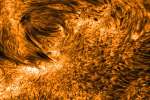
When does the Sun look like a flower? In a specific color of red light emitted by hydrogen, as featured here, some regions of the solar chromosphere may resemble a rose. The color-inverted image was taken in 2014 October and shows active solar region 2177.
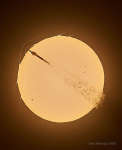 APOD: 2026 June 15 Б Triple Shockwave from Sun Crossing Rocket
15.06.2026
What's happening to this Sun-crossing rocket? The SpaceX Falcon 9 rocket, visible on the upper left, launched only about one minute before this amazing image was captured. As it rose to low Earth...
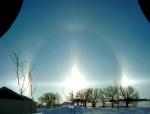 Sun Halo at Winter Solstice
14.01.2002
Sometimes it looks like the Sun is being viewed through a large lens. In the above case, however, there are actually millions of lenses: ice crystals. As water freezes in the upper atmosphere, small, flat, six-sided, ice crystals might be formed.
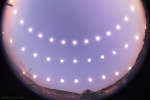 Equinox: The Sun from Solstice to Solstice
22.09.2008
Today is an equinox, a date when day and night are equal. Tomorrow, and every day until the next equinox, the night will be longer than the day in Earth's northern hemisphere, and the day will be longer than the night in Earth's southern hemisphere.
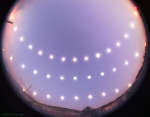 Equinox: The Sun from Solstice to Solstice
23.09.2012
Yesterday was an equinox, a date when day and night are equal. Today, and every day until the next equinox, the night will be longer than the day in Earth's northern hemisphere, and the day will be longer than the night in Earth's southern hemisphere.
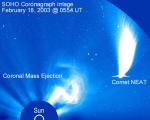 Comet NEAT Passes an Erupting Sun
24.02.2003
As Comet NEAT flared last week, the Sun roared. Just as the comet swooped inside the orbit of Mercury and developed a long and flowing tail of gas and dust, the Sun emitted a huge Coronal Mass Ejection (CME).
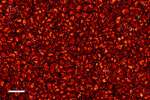 Bright Points on the Quiet Sun
16.04.2010
Up close, the solar surface is a striking patch work of granules in this very high resolution picture of the quiet Sun. Caused by convection, the granules are hot, rising columns of plasma edged by dark lanes of cooler, descending plasma.
 Spicules: Jets on the Sun
2.11.2008
Imagine a pipe as wide as a state and as long as half the Earth. Now imagine that this pipe is filled with hot gas moving 50,000 kilometers per hour. Further imagine that this pipe is not made of metal but a transparent magnetic field.
|
January February March April May June July August September |
|||||||||||||||||||||||||||||||||||||||||||||||||