
|
You entered: Sun
 A Year in Sunsets
20.12.2024
A year in sunsets, from April 2023 to March 2024, track along the western horizon in these stacked panoramic views. The well-planed sequence is constructed of images recorded near the 21st day of the indicated month from the same location overlooking Cairo, Egypt.
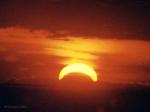 A Crescent Sunrise
17.08.1999
Normally, the Moon shows phases, but the Sun does not. The reason is founded in the fact that the Moon shines only by reflected sunlight. When the Moon is closer to the Sun than the Earth, only part of it appears to be lit - resulting in a familiar crescent-shaped phase.
 Equinox Plus 1
20.03.2010
Twice a year, at the Spring and Fall equinox, the Sun rises due east. In an emphatic demonstration of this celestial alignment, photographer Joe Orman recorded this inspiring image of the Sun rising exactly along the east-west oriented Western Canal, in Tempe, Arizona, USA.
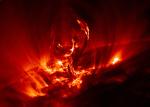 A Solar Filament Lifts Off
9.08.2000
Hot gas frequently erupts from the Sun. One such eruption produced the glowing filament pictured above, which was captured on July 19 by the Earth-orbiting TRACE satellite. The filament, although small compared...
 APOD: 2025 November 17 Б Comet Lemmons Wandering Tail
16.11.2025
What has happened to Comet Lemmon's tail? The answer is blowing in the wind Б the wind from the Sun in this case. This continuous outflow of charged particles from...
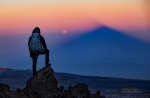 Moonrise and Mountain Shadow
13.03.2020
What phase of the Moon is 3.14 radians from the Sun? The Full Moon, of course. Even though the Moon might look full for several days, the Moon is truly at its full phase when it is 3.14 radians (aka 180 degrees) from the Sun in ecliptic longitude.
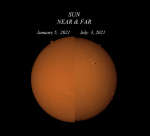 Perihelion to Aphelion
7.07.2021
Aphelion for 2021 occurred on July 5th. That's the point in Earth's elliptical orbit when it is farthest from the Sun. Of course, the distance from the Sun doesn't determine the seasons.
 A Martian Halloween
30.10.2005
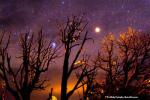
From sunset to sunrise, an unusually bright yellowish orb will hang in the sky this Halloween: Mars. Yesterday, Earth passed Mars as they orbited the Sun, bringing Mars closer than it will be for the next thirteen years. Tonight though, Mars will be nearly as bright as last night, a beacon of extraterrestrial spookiness.
 Large Eruptive Prominence Imaged by STEREO
18.04.2010
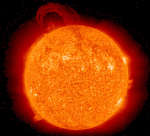
What's happened to our Sun? Last week, it produced one of the most power eruptive prominences ever seen. Pictured above, the prominence erupted in only a few hours and was captured in movie form by NASA's twin Sun-orbiting STEREO satellites.
 Double Eruptive Prominences
18.04.2003
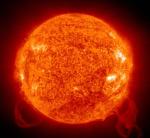
Lofted over the Sun on looping magnetic fields, large solar prominences are composed of relatively cool, dense plasma. When seen against the brilliant solar disk they appear as dark filaments, but these enormous magnetic...
|
January February March April May June July August September |
|||||||||||||||||||||||||||||||||||||||||||||||||