
|
You entered: Sun
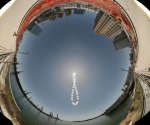 High Noon Analemma Over Azerbaijan
14.10.2013
Is the Sun always straight up at noontime? No. For example, the Sun never appears directly overhead from locations well north or south of the Earth's equator. Conversely, there is always a place on Earth where the Sun will appear at zenith at noon -- for example on the equator during an equinox.
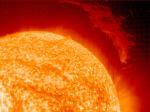 A Prominent Solar Prominence from SOHO
30.03.2004
One of the most spectacular solar sights is a prominence. A solar prominence is a cloud of solar gas held above the Sun's surface by the Sun's magnetic field. Last month, NASA's Sun-orbiting SOHO spacecraft imaged an impressively large prominence hovering over the surface, pictured above.
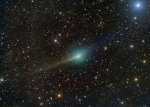 3I/ATLAS Flyby
26.12.2025
Attention grabbing interstellar visitor 3I/ATLAS made its not-so-close flyby of our fair planet on December 19 at a distance of 1.8 astronomical units. That's about 900 light-seconds. This deep exposure captures the comet...
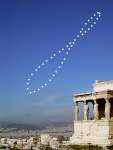 Analemma Over the Porch of Maidens
21.12.2008
If you took a picture of the Sun at the same time each day, would it remain in the same position? The answer is no, and the shape traced out by the Sun over the course of a year is called an analemma.
 APOD: 2023 May 17 Б Sunspot with Light Bridge
17.05.2023
Why would a small part of the Sun appear slightly dark? Visible is a close-up picture of sunspots, depressions on the Sun's surface that are slightly cooler and less bright than the rest of the Sun. The Sun's complex magnetic field creates these cool regions by inhibiting hot material from entering the spots.
 Kepler Discovers How Planets Move
13.09.1997
Johannes Kepler used simple mathematics to describe how planets move. Kepler was an assistant to the most accurate astronomical observer of the time, Tycho Brahe. Kepler was able to use Brahe's data...
 A Partial Solar Eclipse over Buenos Aires
20.02.2018
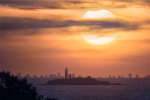
What's happened to top of the Sun? Last week, parts of Earth's southern hemisphere were treated to a partial solar eclipse, where the Moon blocks out part of the Sun. The featured image was taken toward the end of the eclipse from the coast of Uruguay overlooking Argentina's Buenos Aires.
 Comet ISON Rising
27.11.2013
Will Comet ISON survive tomorrow's close encounter with the Sun? Approaching to within a solar diameter of the Sun's surface, the fate of one of the most unusual comets of modern times will finally be determined.
 Kepler Discovers How Planets Move
31.08.1996
Johannes Kepler used simple mathematics to describe how planets move. Kepler was an assistant to the most accurate astronomical observer of the time, Tycho Brahe. Kepler was able to use Brahe's data...
 A Solar Filament Lifts Off
25.07.2004
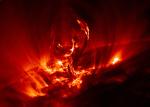
Hot gas frequently erupts from the Sun. One such eruption produced the glowing filament pictured above, which was captured in 2000 July by the Earth-orbiting TRACE satellite. The filament, although small compared...
|
January February March April May June July August September |
|||||||||||||||||||||||||||||||||||||||||||||||||