
|
You entered: Sun
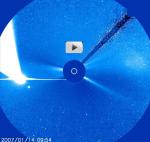 SOHO: Comet McNaught Movie
20.01.2007
This frame from a spectacular time lapse movie shows Comet McNaught - the Great Comet of 2007 - sweeping through the inner solar system. The movie frames were recorded from January 12 through Jan 16 by a coronograph onboard the sun-staring SOHO spacecraft.
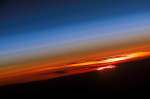 Sunset: Planet Earth
20.03.2008
Today, the Sun crosses the celestial equator heading north at 0548 UT. Known as the equinox, the geocentric astronomical event marks the first day of spring in the northern hemisphere and autumn in the south.
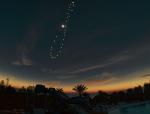 Tutulemma: Solar Eclipse Analemma
2.10.2007
If you went outside at exactly the same time every day and took a picture that included the Sun, how would the Sun appear to move? With great planning and effort, such a series of images can be taken. The figure-8 path the Sun follows over the course of a year is called an analemma.
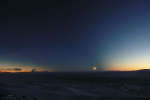 Eclipse Shadow Cone Over Patagonia
4.08.2010
Sometimes, during a total eclipse of the Sun, a strange shadow of darkness can be seen stretching off into the distance. Called shadow cones, they are visible because the Earth's atmosphere is not completely transparent, scattering sunlight and hence appearing blue during the day.
 APOD: 2024 April 10 Б Planets Around a Total Eclipse
10.04.2024
What wonders appear when the Moon blocks the Sun? For many eager observers of MondayБs total eclipse of the Sun, the suddenly dark sky included the expected corona and two (perhaps surprise) planets: Venus and Jupiter.
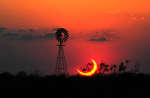 A Partial Solar Eclipse over Texas
22.05.2012
It was a typical Texas sunset except that most of the Sun was missing. The location of the missing piece of the Sun was not a mystery -- it was behind the Moon. Sunday night's partial eclipse of the Sun by the Moon turned into one of the best photographed astronomical events in history.
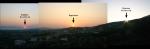 Sunrise by Season
21.12.2005
Does the Sun always rise in the same direction? No. As the seasons change, the direction toward the rising Sun will change, too. The Sun will always rise and set furthest to the south during the day of Winter Solstice, and furthest to the north during Summer Solstice.
 Five Bright Comets from SOHO
10.10.2024
Five bright comets are compared in these panels, recorded by a coronograph on board the long-lived, sun-staring SOHO spacecraft. Arranged chronologically all are recognizable by their tails streaming away from...
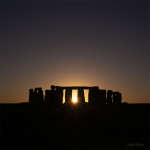 APOD: 2025 December 22 Б Sunset Solstice over Stonehenge
22.12.2025
Yesterday the Sun reached its southernmost point in planet Earth's sky. Called a solstice, many cultures mark yesterday's date as a change of seasons -- from autumn to winter in Earth's Northern Hemisphere and from spring to summer in Earth's Southern Hemisphere.
 Crescents of Venus
26.08.2023
Just as the Moon goes through phases, Venus' visible sunlit hemisphere waxes and wanes. This sequence of telescopic images illustrates the steady changes for Venus during its recent 2023 apparition as our evening star. Gliding along its interior orbit between Earth and Sun, Venus grows larger during that period because it is approaching planet Earth.
|
January February March April May June July August September |
|||||||||||||||||||||||||||||||||||||||||||||||||