
|
You entered: Sun
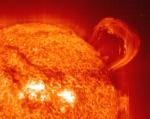 Equinox and Eruptive Prominence
23.09.1999
Today, the Sun crosses the celestial equator and seasons change from Summer to Fall in the north and Winter to Spring in the southern hemisphere. Defined by the Sun's position in sky the event is known as an equinox - the length of daylight is equal to the length of night.
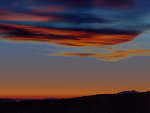 Mercury on the Horizon
27.01.2008
Have you ever seen the planet Mercury? Because Mercury orbits so close to the Sun, it never wanders far from the Sun in Earth's sky. If trailing the Sun, Mercury will be visible low on the horizon for only a short while after sunset.
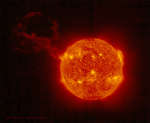 Record Prominence Imaged by Solar Orbiter
2.03.2022
What's happened to our Sun? Last month, it produced the largest prominence ever imaged together with a complete solar disk. The record image, featured, was captured in ultraviolet light by the Sun-orbiting Solar Orbiter spacecraft.
 Omega Sunrise
21.09.2020
Capturing this sunrise required both luck and timing. First and foremost, precise timing was needed to capture a sailboat crossing right in front of a rising Sun. Additionally, by a lucky coincidence, the background Sun itself appears unusual -- it looks like the Greek letter Omega (н).
 Annular Eclipse: The Ring of Fire
10.06.2002
Today, a few lucky people will see a "ring of fire." That's a name for the central view of an annular eclipse of the Sun by the Moon. At the peak of this...
 APOD: 2026 July 19 Б Flying Saucer Crash Lands in Utah Desert
19.07.2026
A flying saucer from outer space crash-landed in the Utah desert after being tracked by radar and chased by helicopters. The year was 2004, and no space aliens were involved. The saucer, pictured here...
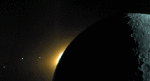 The Ecliptic Plane
21.09.1996
The Plane of the Ecliptic is illustrated in this Clementine star tracker camera image which reveals (from right to left) the Moon lit by Earthshine, the Sun's corona rising over the Moon's dark limb, and the planets Saturn, Mars, and Mercury.
 Kepler Discovers How Planets Move
6.06.1999
Johannes Kepler used simple mathematics to describe how planets move. Kepler was an assistant to the most accurate astronomical observer of the time, Tycho Brahe. Kepler was able to use Brahe's data...
 Kepler Discovers How Planets Move
14.01.2001
Johannes Kepler used simple mathematics to describe how planets move. Kepler was an assistant to the most accurate astronomical observer of the time, Tycho Brahe. Kepler was able to use Brahe's data...
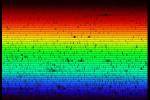 The Solar Spectrum
15.08.2000
It is still not known why the Sun's light is missing some colors. Shown above are all the visible colors of the Sun, produced by passing the Sun's light through a prism-like device.
|
January February March April May June July August September |
|||||||||||||||||||||||||||||||||||||||||||||||||