
|
You entered: Sun
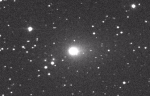 Hyakutake: The Great Comet of 1996?
8.02.1996
Get ready for one of the most impressive but least anticipated light shows in modern astronomical history. Next month, newly discovered Comet Hyakutake will pass closer to the Earth than any recent comet. Unknown...
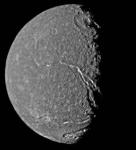 Titania's Trenches
11.01.1997
British astronomer Sir William Herschel discovered Titania and Oberon in 1787, 210 years ago today. He wasn't reading Shakespeare's A Midsummer Night's Dream though, he was making the first telescopic observations of moons of the planet Uranus (a planet which he himself discovered in 1781).
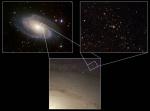 Supernova Survivor
12.02.2004
Beginning with a full view of beautiful spiral galaxy M81, follow the insets (left, bottom, then right) to zoom in on a real survivor. Seen at the center of the final field on the right is a star recently identified as the survivor of a cosmic cataclysm -- the supernova explosion of its companion star.
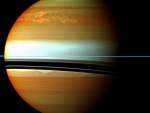 A Raging Storm System on Saturn
28.04.2013
It was one of the largest and longest lived storms ever recorded in our Solar System. First seen in late 2010, the above cloud formation in the northern hemisphere of Saturn started larger than the Earth and soon spread completely around the planet.
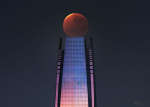 Lunar Eclipse over a Skyscraper
22.11.2021
Why is the Moon on top of this building? Planning. It took the astrophotographer careful planning -- including figuring out exactly where to place the camera and exactly when to take the shot -- to create this striking superposition.
 APOD: 2024 July 1 Б Time Spiral
1.07.2024
What's happened since the universe started? The time spiral shown here features a few notable highlights. At the spiral's center is the Big Bang, the place where time, as we know it, began about 13.8 billion years ago.
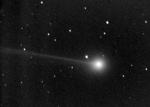 Comet Ikeya Zhang
21.02.2002
Comet Ikeya-Zhang is presently heading north in planet Earth's sky, framed by stars of the constellation Cetus. The comet was discovered as a faint, telescopic object near the western horizon on the evening...
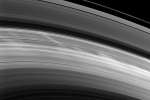 Spokes Reappear on Saturns Rings
2.06.2009
What causes the mysterious spokes in Saturn's rings? Visible in the above image as light ghostlike impressions, spokes were first discovered by the Voyager spacecraft that buzzed by Saturn in the early 1980s. Their existence was unexpected.
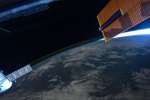 Perseid Below
17.08.2011
Denizens of planet Earth watched this year's Perseid meteor shower by looking up into the moonlit night sky. But this remarkable view captured by astronaut Ron Garan looks down on a Perseid meteor.
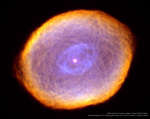 IC 418: The Spirograph Nebula
11.06.2017
What is creating the strange texture of IC 418? Dubbed the Spirograph Nebula for its resemblance to drawings from a cyclical drawing tool, planetary nebula IC 418 shows patterns that are not well understood. Perhaps they are related to chaotic winds from the variable central star, which changes brightness unpredictably in just a few hours.
|
January February March April May June July August September |
|||||||||||||||||||||||||||||||||||||||||||||||||