
|
You entered: Sun
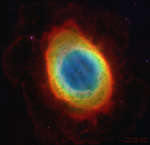 M57: The Ring Nebula from Hubble
16.08.2021
Except for the rings of Saturn, the Ring Nebula (M57) is probably the most famous celestial circle. Its classic appearance is understood to be due to our own perspective, though. The recent mapping...
 APOD: 2024 February 12 Б HFG1 & Abell 6: Planetary Nebulae
11.02.2024
Planetary nebulae like Heckathorn-Fesen-Gull 1 (HFG1) and Abell 6 in the constellation Cassiopeia are remnants from the last phase of a medium sized star like our Sun. In spite of their shapes, planetary nebulae have nothing in common with actual planets.
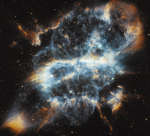 NGC 5189: An Unusually Complex Planetary Nebula
19.12.2012
Why is this nebula so complex? When a star like our Sun is dying, it will cast off its outer layers, usually into a simple overall shape. Sometimes this shape is a sphere, sometimes a double lobe, and sometimes a ring or a helix.
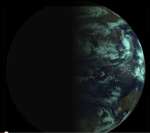 Earth at Equinox
22.09.2014
Earth is at equinox. Over the next 24 hours, day and night have nearly equal duration all over planet Earth. Technically, equinox transpires at 2:29 am Universal Time tomorrow, but this occurs today in North and South America.
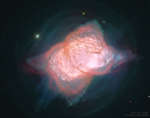 Bright Planetary Nebula NGC 7027 from Hubble
8.01.2018
It is one of the brightest planetary nebulae on the sky -- what should it be named? First discovered in 1878, nebula NGC 7027 can be seen toward the constellation of the Swan (Cygnus) with a standard backyard telescope.
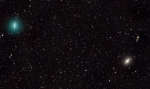 Comet Iwamoto and the Sombrero Galaxy
8.02.2019
Comet Iwamoto (C/2018 Y1), shows off a pretty, greenish coma at the upper left in this telescopic field of view. Taken on February 4 from the Mount John Observatory, University of Canterbury...
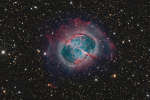 M27: Not a Comet
28.08.2019
While hunting for comets in the skies above 18th century France, astronomer Charles Messier diligently kept a list of the things he encountered that were definitely not comets. This is number 27 on his now famous not-a-comet list.
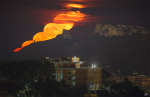 Strawberry Supermoon Over Devils Saddle
3.07.2022
Near the horizon the full moon often seems to loom large, swollen in appearance by the famous Moon illusion. But time-lapse image sequences demonstrate that the Moon's angular size doesn't really change as it rises or sets. Its color does, though.
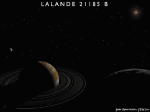 Lalande 21185: The Nearest Planetary System?
19.10.1996
What's the closest extrasolar planetary system? It may well be planets of the dim red dwarf star cataloged as Lalande 21185 -- a mere 8 light years distant. This star is too faint to be seen by the naked eye and its planets have not been imaged directly.
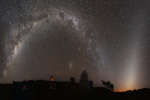 Zodiacal Light Over Namibia
13.09.2010
An unusual triangle of light is visible this time of year just before dawn, in the northern hemisphere. Once considered a false dawn, this triangle of light is actually zodiacal light, light reflected from interplanetary dust particles.
|
January February March April May June July August September |
|||||||||||||||||||||||||||||||||||||||||||||||||