
|
You entered: Sun
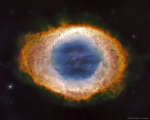 M57: The Ring Nebula
17.04.2018
Except for the rings of Saturn, the Ring Nebula (M57) is probably the most famous celestial band. Its classic appearance is understood to be due to our own perspective, though. The recent mapping...
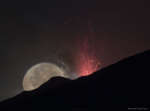 Moon behind Lava Fountain
4.09.2018
What's happened to the Moon? Nothing, but something has happened to the image of the Moon. The heat from a volcanic lava fountain in the foreground has warmed and made turbulent the air nearby, causing passing light to refract differently than usual.
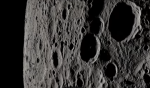 Apollo 13 Views of the Moon
3.03.2020
What if the only way to get back to Earth was to go around the far side of the Moon? Such was the dilemma of the Apollo 13 Crew in 1970 as they tried to return home in their unexpectedly damaged spacecraft.
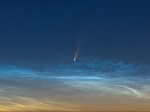 Comet NEOWISE Rising over the Adriatic Sea
13.07.2020
This sight was worth getting out of bed early. Comet C/2020 F3 (NEOWISE) has been rising before dawn during the past week to the delight of northern sky enthusiasts awake that early. Up before...
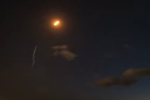 Streak and Plume from SpaceX Crew2 Launch
24.04.2021
What's happening in the sky? The pre-dawn sky first seemed relatively serene yesterday morning over Indian Harbor Beach in Florida, USA. But then it lit up with a rocket launch. Just to the north, NASA's SpaceX Crew-2 Mission blasted into space aboard a powerful Falcon 9 rocket.
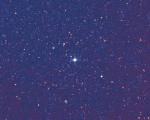 A Close Encounter of the Stellar Kind
26.06.1997
The unassuming star centered in this sky view will one day be our next door stellar neighbor. The faint 9th magnitude red dwarf currently 63 light-years away in the constellation Ophiucus was recently discovered to be on a course toward our Solar System.
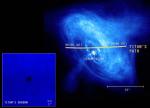 Titan s X Ray
29.04.2004
This June's rare and much heralded transit of Venus will feature our currently brilliant evening star in silhouette, as the inner planet glides across the face of the Sun. But on January 5, 2003 and even rarer transit took place.
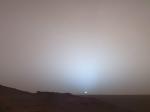 Sunset Over Gusev Crater
20.06.2005
What would it be like to see a sunset on Mars? To help find out, the robotic rover Spirit was deployed last month to park and serenely watch the Sun dip below the distant lip of Gusev crater. It was a tough job, but some robot had to do it.
 Mira: The Wonderful Star
22.07.2006
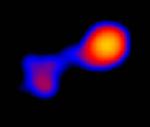
To seventeenth century astronomers, Omicron Ceti or Mira was known as a wonderful star - a star whose brightness could change dramatically in the course of about 11 months. Modern astronomers now recognize an entire class of long period Mira-type variables as cool, pulsating, red giant stars, 700 or so times the diameter of the Sun.
 Shadows at the Lunar South Pole
23.04.2011
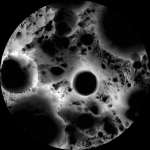
What is it? It's a multi-temporal illumination map, of course. To make it, the wide angle camera on the Lunar Reconnaissance Orbiter spacecraft collected 1,700 images over a period of 6 lunar days (6 Earth months), repeatedly covering an area centered on the Moon's south pole.
|
January February March April May June July August September |
|||||||||||||||||||||||||||||||||||||||||||||||||