
|
You entered: Sun
 APOD: 2024 May 24 Б M78 from the Euclid Space Telescope
24.05.2024
Star formation can be messy. To help find out just how messy, ESA's new Sun-orbiting Euclid telescope recently captured the most detailed image ever of the bright star forming region M78. Near...
 APOD: 2026 June 28 Б AR 4478: Giant Sunspot Group
28.06.2026
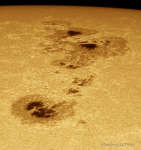
Right now, one of the largest sunspot groups in recent history is crossing the Sun. Active Region 4478 is not only big -- it's violent, showing tangled magnetic fields capable of throwing off huge clouds of particles into the Solar System. Some of these CMEs might impact the Earth.
 The Coldest Brown Dwarf
30.08.2011
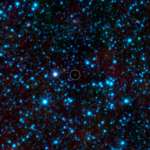
This cosmic snapshot composed with image data from NASA's Wide-field Infrared Survey Explorer (WISE) satellite captures a multitude of faint stars and distant galaxies toward the constellation Lyra at wavelengths longer than visible light. But the object circled at the center is not quite a star.
 Perseid Below
10.08.2012
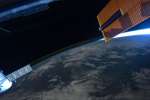
Denizens of planet Earth watched last year's Perseid meteor shower by looking up into the bright moonlit night sky. But this remarkable view captured on August 13, 2011 by astronaut Ron Garan looks down on a Perseid meteor.
 Rainbow Airglow over the Azores
22.03.2016
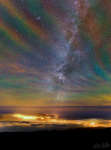
Why would the sky glow like a giant repeating rainbow? Airglow. Now air glows all of the time, but it is usually hard to see. A disturbance however -- like an approaching storm -- may cause noticeable rippling in the Earth's atmosphere.
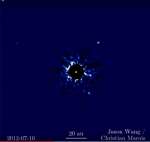 Four Planets Orbiting Star HR 8799
1.02.2017
Does life exist outside our Solar System? To help find out, NASA has created the Nexus for Exoplanet System Science (NExSS) to better locate and study distant star systems that hold hope of harboring living inhabitants.
 APOD: 2025 April 27 Б IC 418: The Spirograph Nebula
27.04.2025
What is creating the strange texture of IC 418? Dubbed the Spirograph Nebula for its resemblance to drawings from a cyclical drawing tool, planetary nebula IC 418 shows patterns that are not well understood. Perhaps they are related to chaotic winds from the variable central star, which changes brightness unpredictably in just a few hours.
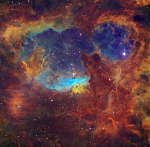 Massive Stars in NGC 6357
5.02.2016
Massive stars lie within NGC 6357, an expansive emission nebula complex some 6,500 light-years away toward the tail of the constellation Scorpius. In fact, positioned near center in this ground-based close-up...
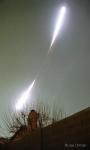 Eclipse Moon Trail
13.10.2000
Tonight, Friday the 13th, October's big, bright, beautiful full Moon will be in the sky, rising as the sun sets. A time exposure of this evening's full Moon would show a brilliant circular arc or Moon trail tracing its celestial path.
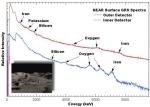 Survivor: NEAR Shoemaker On Asteroid Eros
5.03.2001
Not part of a television game series, the NEAR Shoemaker spacecraft survived its unprecedented landing on an on asteroid last month. As suggested in the illustration inset above, the car-sized probe likely rests gently on the tips of its solar panels having touched down under the influence of asteroid Eros' feeble gravity.
|
January February March April May June July August September |
|||||||||||||||||||||||||||||||||||||||||||||||||