
|
You entered: Sun
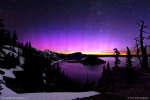 Pink Aurora Over Crater Lake
25.07.2012
Why is this aurora strikingly pink? When photographing picturesque Crater Lake in Oregon, USA last month, the background sky lit up with auroras of unusual colors. Although much is known about the physical mechanisms that create auroras, accurately predicting the occurrence and colors of auroras remains a topic of investigation.
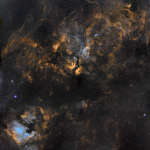 Clouds in Cygnus
30.11.2012
Cosmic clouds of gas and dust drift across this magnificent mosaic covering a 12x12 degree field within the high flying constellation Cygnus. The collaborative skyscape, a combination of broad and narrow band image data presented in the Hubble palette, is anchored by bright, hot, supergiant star Deneb, below center near the left edge.
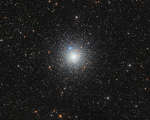 Globular Star Cluster NGC 6752
23.01.2020
Some 13,000 light-years away toward the southern constellation Pavo, the globular star cluster NGC 6752 roams the halo of our Milky Way galaxy. Over 10 billion years old, NGC 6752 follows clusters Omega Centauri and 47 Tucanae as the third brightest globular in planet Earth's night sky.
 NGC 2392: Double Shelled Planetary Nebula
16.02.2020
To some, this huge nebula resembles a person's head surrounded by a parka hood. In 1787, astronomer William Herschel discovered this unusual planetary nebula: NGC 2392. More recently, the Hubble Space Telescope imaged the nebula in visible light, while the nebula was also imaged in X-rays by the Chandra X-ray Observatory.
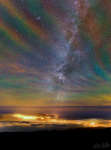 Rainbow Airglow over the Azores
18.04.2021
Why would the sky glow like a giant repeating rainbow? Airglow. Now air glows all of the time, but it is usually hard to see. A disturbance however -- like an approaching storm -- may cause noticeable rippling in the Earth's atmosphere.
 Hale-Bopp: The Great Comet of 1997
8.04.2022
Only twenty-five years ago, Comet Hale-Bopp rounded the Sun and offered a dazzling spectacle in planet Earth's night skies. Digitized from the original astrophoto on 35mm color slide film, this classic image of the Great Comet of 1997 was recorded a few days after its perihelion passage on April 1, 1997.
 Sharpless 308: The Dolphin Head Nebula
7.06.2024
Blown by fast winds from a hot, massive star, this cosmic bubble is huge. Cataloged as Sharpless 2-308 it lies some 5,000 light-years away toward the well-trained constellation Canis Major and covers slightly more of the sky than a Full Moon. That corresponds to a diameter of 60 light-years at its estimated distance.
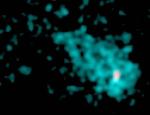 IC443's Neutron Star
15.12.2000
Using x-ray data from the orbiting Chandra Observatory along with radio data from the Very Large Array, a team of researchers has discovered evidence for a new example of one of the most bizarre objects known to modern astrophysics -- a neutron star.
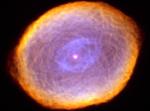 IC 418: The Spirograph Nebula
30.09.2001
What is creating the strange texture of IC 418? Dubbed the Spirograph Nebula for its resemblance to drawings from a cyclical drawing tool, planetary nebula IC 418 shows patterns that are not well understood. Perhaps they are related to chaotic winds from the variable central star, which changes brightness unpredictably in just a few hours.
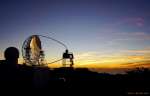 Cherenkov Telescope at Sunset
18.10.2018
On October 10, a new telescope reflected the light of the setting Sun. With dark horizon above and sunset colors below, its segmented mirror inverts an image of the beautiful evening sky in this snapshot from the Roque del Los Muchachos Observatory on the Canary Island of La Palma.
|
January February March April May June July August September |
|||||||||||||||||||||||||||||||||||||||||||||||||