
|
You entered: Sun
 The Light of Stars
8.05.2012
What's moving? Time lapse videos of the sky can be quite spectacular when they last long enough for stars, planets, aurora, and clouds to appear to move in just a few seconds. Pictured...
 A Plurality of Singularities at the Galactic Center
12.05.2018
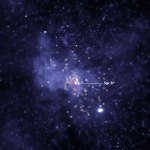
A recent informal poll found that astronomers don't yet have a good collective noun for a group of black holes, but they need one. The red circles in this Chandra Observatory X-ray image identify a group of a dozen black holes that are members of binary star systems.
 Jones Emberson 1
12.07.2024
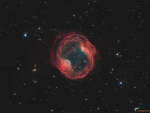
Planetary nebula Jones-Emberson 1 is the death shroud of a dying Sun-like star. It lies some 1,600 light-years from Earth toward the sharp-eyed constellation Lynx. About 4 light-years across, the expanding remnant...
 APOD: 2025 August 27 Б WISPIT 2b: Exoplanet Carves Gap in Birth Disk
27.08.2025
That yellow spot -- what is it? It's a young planet outside our Solar System. The featured image from the Very Large Telescope in Chile surprisingly captures a distant scene much like our own Solar System's birth, some 4.5 billion years ago.
 APOD: 2026 February 11 Б A Year of Sunspots
11.02.2026
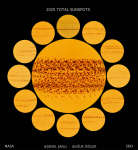
How many sunspots can you see? The central image shows the many sunspots that occurred in 2025, month by month around the circle, and all together in the grand central image. Each sunspot is magnetically cooled and so appears dark -- and can last from days to months.
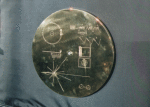 The Voyagers' Message in a Bottle
29.06.1996
Launched in the summer of 1977, NASA's Voyager 1 and 2 spacecraft are now over 4.5 billion miles from the Sun. Still operational, the Voyagers are being tracked and commanded through the Deep Space Network.
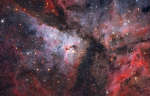 The Great Carina Nebula
27.12.2018
A jewel of the southern sky, the Great Carina Nebula, also known as NGC 3372, spans over 300 light-years, one of our galaxy's largest star forming regions. Like the smaller, more northerly Great...
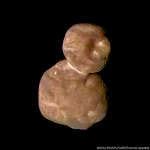 Ultima Thule from New Horizons
29.01.2019
How do distant asteroids differ from those near the Sun? To help find out, NASA sent the robotic New Horizons spacecraft past the classical Kuiper belt object 2014 MU69, nicknamed Ultima Thule, the farthest asteroid yet visited by a human spacecraft.
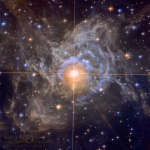 RS Puppis
17.05.2019
Pulsating RS Puppis, the brightest star in the image center, is some ten times more massive than our Sun and on average 15,000 times more luminous. In fact, RS Pup is a Cepheid...
 APOD: 2025 November 23 Б The Observable Universe
23.11.2025
How far can you see? Everything you can see, and everything you could possibly see, right now, assuming your eyes could detect all types of radiations around you -- is the observable universe. In light...
|
January February March April May June July August September |
|||||||||||||||||||||||||||||||||||||||||||||||||