
|
You entered: time
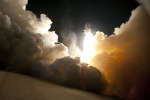 Night Launch of the Space Shuttle Endeavour
9.02.2010
Sometimes, the space shuttle launches at night. Pictured above, the space shuttle Endeavour lifted off in yesterday's early morning hours from Launch Pad 39A in Kennedy Space Center, Florida, USA, bound for the International Space Station (ISS).
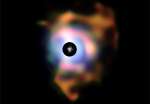 Stardust and Betelgeuse
28.06.2011
An expansive nebula of dust is seen to surround red supergiant star Betegeuse in this remarkable high resolution composite, an infrared VLT image from the European Southern Observatory. Betelgeuse itself is outlined by the small, central red circle. If found in our own solar system its diameter would almost encompass the orbit of Jupiter.
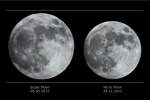 Super Moon vs Micro Moon
8.09.2014
What is so super about tomorrow's supermoon? Tomorrow, a full moon will occur that appears slightly larger and brighter than usual. The reason is that the Moon's fully illuminated phase occurs within a short time from perigee - when the Moon is its closest to the Earth in its elliptical orbit.
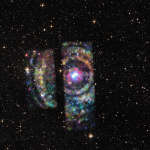 X ray Echoes from Circinus X 1
5.08.2015
Circinus X-1 is an X-ray binary star known for its erratic variability. In the bizarre Circinus X-1 system, a dense neutron star, the collapsed remnant of a supernova explosion, orbits with a more ordinary stellar companion.
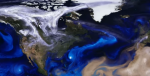 Hurricane Season Animated
27.11.2017
Where do hurricanes go? To better understand dangerous storms, NASA compiled data from several satellites into a supercomputer simulation of this past year's hurricane season. Specifically, the featured video shows how smoke (white), sea salt (blue), and dust (brown) tracked from 2017 August through October across the northern half of Earth's Western Hemisphere.
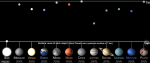 Solar System Ball Drop
25.08.2021
Does a ball drop faster on Earth, Jupiter, or Uranus? The featured animation shows a ball dropping from one kilometer high toward the surfaces of famous solar system bodies, assuming no air resistance. The force of gravity depends on the mass of the attracting object, with higher masses pulling down with greater forces.
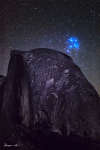 Pleiades over Half Dome
19.07.2022
Stars come in bunches. The most famous bunch of stars on the sky is the Pleiades, a bright cluster that can be easily seen with the unaided eye. The Pleiades lies only about 450 light years away, formed about 100 million years ago, and will likely last about another 250 million years.
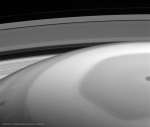 Cassini Looks Out from Saturn
23.12.2022
This is what Saturn looks like from inside the rings. In 2017, for the first time, NASA directed the Cassini spacecraft to swoop between Saturn and its rings. During the dive, the robotic spacecraft took hundreds of images showing unprecedented detail for structures in Saturn's atmosphere.
 APOD: 2024 October 30 Б NGC 7635: The Bubble Nebula
30.10.2024
What created this huge space bubble? Blown by the wind from a star, this tantalizing, head-like apparition is cataloged as NGC 7635, but known simply as the Bubble Nebula. The featured striking view utilizes a long exposure to reveal the intricate details of this cosmic bubble and its environment.
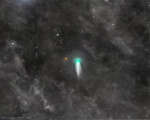 APOD: 2026 August 24 Б Comet 220P in Outburst
24.08.2026
Comet 220P is unexpectedly bright. Normally, periodic Comet 220P/McNaught is so dim that to see it requires a telescope. Two surprising outbursts this year, however, have made it about 20,000 times brighter than usual, so that it is now visible with binoculars and long-duration camera exposures.
|
January February March April May June July August September |
|||||||||||||||||||||||||||||||||||||||||||||||||