
|
You entered: time
 APOD: 2023 May 3 Б Centaurus A: A Peculiar Island of Stars
3.05.2023
Galaxies are fascinating. In galaxies, gravity alone holds together massive collections of stars, dust, interstellar gas, stellar remnants and dark matter. Pictured is NGC 5128, better known as Centaurus A. Cen A is the fifth brightest galaxy on the sky and is located at a distance of about 12 million light years from Earth.
 APOD: 2023 November 6 Б Red Aurora over Italy
6.11.2023
What was that red glow on the horizon last night? Aurora. Our unusually active Sun produced a surface explosion a few days ago that sent out a burst of electrons, protons, and more massive charged nuclei.
 APOD: 2025 August 19 Б Giant Galaxies in Pavo
19.08.2025
Over 500,000 light years across, NGC 6872 (bottom left) is a truly enormous barred spiral galaxy. At least 5 times the size of our own large Milky Way, NGC 6872 is the largest known spiral galaxy.
 Rockets and Robert Goddard
18.07.1998
Robert H. Goddard, one of the founding fathers of modern rocketry, was born in Worcester Massachusetts in 1882. As a 16 year old, Goddard read H.G. Wells' science fiction classic "War Of The Worlds" and dreamed of spaceflight. By 1926 he had designed, built, and launched the world's first liquid fuel rocket.
 Ring of Fire Revisited
30.05.2003
Early on Saturday, May 31 (UT) the new Moon will once again slide across the Sun's fiery disk, and once again an annular solar eclipse will be the result -- since the Moon's apparent diameter will be a little too small to completely cover the Sun.
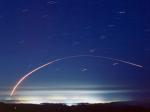 Aura Launch
22.07.2004
In this alluring time exposure, star trails arc across the night sky above Monterey Bay and the lights of Santa Cruz, California, USA. But since the exposure began around 3:01am PDT on July 15 it also records the long trail of a Delta II rocket lofting NASA's Aura spacecraft into Earth orbit.
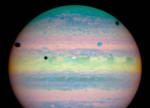 Pastel Planet, Triple Eclipse
11.11.2004
This false-color image of banded gas giant Jupiter shows a triple eclipse in progress on March 28 - a relatively rare event, even for a large planet with many moons. Captured by the Hubble Space...
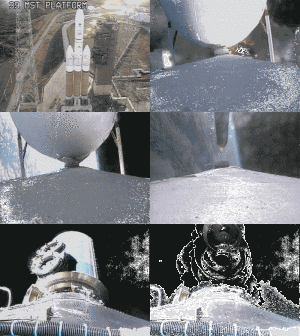 First Launch of the Delta IV Heavy
26.01.2005
The new Delta IV Heavy Launch Vehicle is the largest rocket ever to be launched by the US Air Force. The Delta IV Heavy is capable of launching over 23,000 kilograms into low Earth orbit.
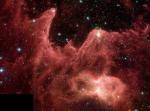 Mountains of Creation
11.11.2005
This fantastic skyscape lies at the eastern edge of giant stellar nursery W5, about 7,000 light-years away in the constellation Cassiopeia. An infrared view from the Spitzer Space Telescope, it features interstellar clouds...
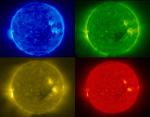 The View from Stereo Ahead
22.12.2006
On December 22nd, at 0022 Universal Time the Sun reached its southernmost point in Earth's sky marking the final season change for the year 2006. In celebration of the Solstice, consider these images of the Sun from an extreme ultraviolet telescope onboard the Stereo Ahead spacecraft.
|
January February March April May June July August September |
|||||||||||||||||||||||||||||||||||||||||||||||||