
|
You entered: time
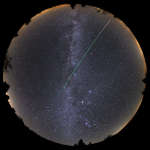 Night of the Long Leonid
22.11.2012
A cosmic grain of sand left the long and colorful trail across this all-sky view. Its grazing impact with planet Earth's atmosphere began at 71 kilometers per second. With the Milky Way stretching...
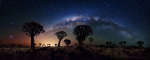 Milky Way Over Quiver Tree Forest
12.12.2012
In front of a famous background of stars and galaxies lies some of Earth's more unusual trees. Known as quiver trees, they are actually succulent aloe plants that can grow to tree-like proportions. The quiver tree name is derived from the historical usefulness of their hollowed branches as dart holders.
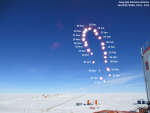 Antarctic Analemma
23.09.2015
Does the Sun return to the same spot on the sky every day? No. A better and more visual answer to that question is an analemma, a composite image taken from the same spot at the same time over the course of a year.
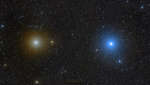 Gemini Stars Pollux and Castor
16.05.2017
Who are the twins of Gemini? It terms of astronomical objects, the famous constellation is dominated by two bright stars: Pollux (left) and Castor (right). Pictured, the two stars stand out because they are so bright, so close together both in angle and brightness, but so different in color.
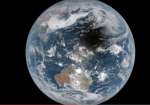 Moon Shadow versus Sun Reflection
17.07.2017
What are those lights and shadows crossing the Earth? As the featured five-second time-lapse video progresses, a full day on planet Earth is depicted as seen from Japan's Himawari-8 satellite in geostationary orbit high above the Pacific Ocean.
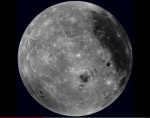 Rotating Moon from LRO
18.03.2018
No one, presently, sees the Moon rotate like this. That's because the Earth's moon is tidally locked to the Earth, showing us only one side. Given modern digital technology, however, combined with many detailed images returned by the Lunar Reconnaissance Orbiter (LRO), a high resolution virtual Moon rotation movie has been composed.
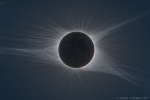 Total Solar Eclipse Corona in HDF
30.04.2018
How great was the Great American Eclipse? The featured HDR image shows it to be perhaps greater than we knew. On August 21 of last year, the Moon blocked the Sun for a few minutes along a narrow path across the USA.
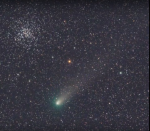 Salt Pepper and Ice
18.09.2018
There's a "camera" comet now moving across the sky. Just a bit too dim to see with the unaided eye, Comet 21P / Giacobini-Zinner has developed a long tail that makes it a good sight for binoculars and sensitive cameras.
 Video: Comet Leonard over One Hour
25.01.2022
Which direction is this comet heading? Judging by the tail, one might imagine that Comet Leonard is traveling towards the bottom right, but a full 3D analysis shows it traveling almost directly away from the camera.
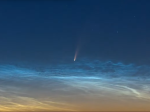 Comet NEOWISE Rising over the Adriatic Sea
26.07.2022
This sight was worth getting out of bed early. Two years ago this month, Comet C/2020 F3 (NEOWISE) rose before dawn to the delight of northern sky enthusiasts awake that early. Up before sunrise...
|
January February March April May June July August September |
|||||||||||||||||||||||||||||||||||||||||||||||||