
|
You entered: time
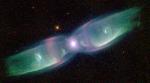 M2-9: Wings of a Planetary Nebula
23.12.1997
Are stars better appreciated for their art after they die? Actually, stars usually create their most artistic displays as they die. In the case of low-mass stars like our Sun and M2-9 pictured above, the stars transform themselves from normal stars to white dwarfs by casting off their outer gaseous envelopes.
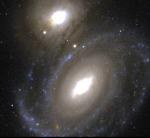 Galaxies Away
26.03.1998
This striking pair of galaxies is far, far away ... about 350 million light-years from Earth. Cataloged as AM0500-620, the pair is located in the southern constellation Dorado. The background elliptical and foreground spiral galaxy are representative of two of the three major classes of galaxies which inhabit our Universe.
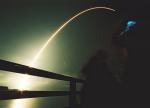 Messenger Launch
14.08.2004
Streaking into the early morning sky on August 3rd, a Delta II rocket launches NASA's Messenger spacecraft on an interplanetary voyage to Mercury. Scheduled to become the first probe to orbit Mercury, Messenger will begin by looping through the inner Solar System in a series of close flybys of planet Earth and Venus.
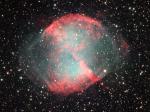 M27: The Dumbbell Nebula
3.06.2005
The first hint of what will become of our Sun was discovered inadvertently in 1764. At that time, Charles Messier was compiling a list of diffuse objects not to be confused with comets.
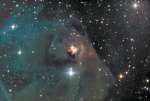 T Tauri and Hind s Variable Nebula
13.12.2007
The orange star centered in this remarkable telescopic skyview is T Tauri, protoytpe of the class of T Tauri variable stars. Nearby it is a dusty yellow cosmic cloud historically known as Hind's Variable Nebula (aka NGC 1555/1554).
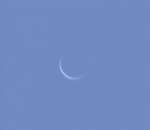 Venus Near Inferior Conjunction
9.04.2009
This remarkable picture of a slender crescent Venus was made during daylight hours on March 26. Venus was then very near inferior conjunction, its closest approach to a point on a line directly between Earth and the Sun.
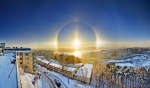 A Sun Halo Beyond Stockholm
10.01.2011
What's happened to the Sun? Sometimes it looks like the Sun is being viewed through a large lens. In the above case, however, there are actually millions of lenses: ice crystals. As water freezes in the upper atmosphere, small, flat, six-sided, ice crystals might be formed.
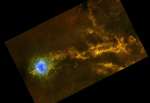 Herschel s Cocoon
19.08.2011
In this remarkable infrared skyscape of interstellar clouds adrift in the high flying constellation Cygnus, the eye is drawn to the Cocoon Nebula. Also known as IC5146, the dusty star forming region is shown...
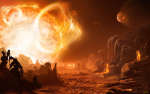 A Dangerous Sunrise on Gliese 876d
29.04.2012
On planet Gliese 876d, sunrises might be dangerous. Although nobody really knows what conditions are like on this close-in planet orbiting variable red dwarf star Gliese 876, the above artistic illustration gives one impression.
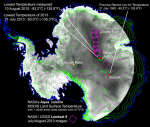 The Coldest Place on Earth
11.12.2013
How cold can it get on Earth? In the interior of the Antarctica, a record low temperature of -93.2 C (-135.8 F) has been recorded. This is about 25 C (45 F) colder than the coldest lows noted for any place humans live permanently.
|
January February March April May June July August September |
|||||||||||||||||||||||||||||||||||||||||||||||||