
|
You entered: time
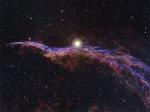 NGC 6960: The Witch's Broom Nebula
31.12.2006
Ten thousand years ago, before the dawn of recorded human history, a new light must suddenly have appeared in the night sky and faded after a few weeks. Today we know this light was an exploding star and record the colorful expanding cloud as the Veil Nebula.
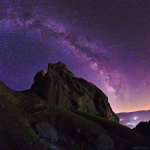 The Starry Night of Alamut
25.06.2010
A meteor's streak and the arc of the Milky Way hang over the imposing mountain fortress of Alamut in this starry scene. Found in the central Alborz Mountains of Iran, Alamut Castle was built into the rock in the 9th century. The name means Eagle's Nest.
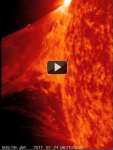 A Solar Prominence Eruption from SDO
6.03.2011
One of the most spectacular solar sights is an erupting prominence. Two weeks ago, NASA's Sun-orbiting Solar Dynamic Observatory spacecraft imaged an impressively large prominence erupting from the surface. The dramatic explosion...
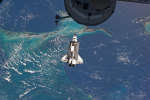 Atlantis Last Approach
13.07.2011
For the last time, the US Space Shuttle has approached the International Space Station (ISS). Following a dramatic launch from Cape Canaveral last week that was witnessed by an estimated one million people, Space Shuttle Atlantis on STS-135 lifted a small crew to a welcome rendezvous three days ago with the orbiting station.
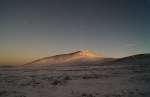 The Snows of Paranal
11.08.2011
Recorded last week, this dawn portrait of snowy mountain and starry sky captures a very rare scenario. The view does feature a pristine sky above the 2,600 meter high mountain Cerro Paranal, but clear skies over Paranal are not at all unusual.
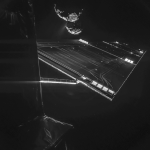 Rosetta s Selfie
16.10.2014
This Rosetta spacecraft selfie was snapped on October 7th. At the time the spacecraft was about 472 million kilometers from planet Earth, but only 16 kilometers from the surface of comet 67P/Churyumov-Gerasimenko. Looming beyond...
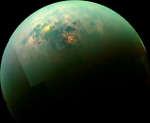 Titan Seas Reflect Sunlight
1.02.2015
Why would the surface of Titan light up with a blinding flash? The reason: a sunglint from liquid seas. Saturn's moon Titan has numerous smooth lakes of methane that, when the angle is right, reflect sunlight as if they were mirrors.
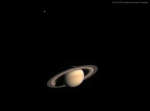 Cassini Approaches Saturn
9.04.2016
Cassini, a robot spacecraft launched in 1997 by NASA, became close enough in 2002 to resolve many rings and moons of its destination planet: Saturn. At that time, Cassini snapped several images during an engineering test. Several of those images were combined into the contrast-enhanced color composite featured here.
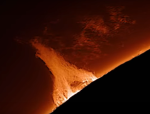 Eiffel Tower Prominence on the Sun
15.02.2022
What's that on the Sun? Although it may look like a flowing version of the Eiffel Tower, it is a solar prominence that is actually much bigger -- about the height of Jupiter.
 APOD: 2023 October 29 Б A Partial Lunar Eclipse
28.10.2023
What's happened to the Moon? Within the last day, part of the Moon moved through the Earth's shadow. This happens about once or twice a year, but not every month since the Moon's orbit around the Earth is slightly tilted.
|
January February March April May June July August September |
|||||||||||||||||||||||||||||||||||||||||||||||||