
|
You entered: time
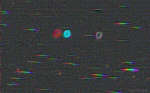 Colors: Ring Nebula versus Stars
21.07.2021
What if you could see, separately, all the colors of the Ring? And of the surrounding stars? There's technology for that. The featured image shows the Ring Nebula (M57) and nearby stars through such technology: in this case, a prism-like diffraction grating.
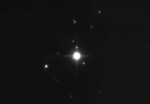 In Motion: Uranus and Moons
30.11.2021
What's that moving across the sky? A planet just a bit too faint to see with the unaided eye: Uranus. The gas giant out past Saturn was tracked earlier this month near opposition -- when it was closest to Earth and at its brightest.
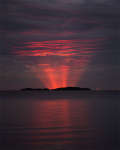 Red Crepuscular Rays from an Eclipse
30.05.2022
What's happening behind that island? Things both expected and unexpected. Expected, perhaps, the pictured rays of light -- called crepuscular rays -- originate from the Sun. Unexpected, though, the Sun was being partially eclipsed by the Moon at the time -- late last month.
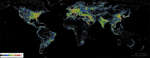 APOD: 2023 March 8 Б Artificial Night Sky Brightness
8.03.2023
Where have all the dim stars gone? From many places on the Earth including major cities, the night sky has been reduced from a fascinating display of thousands of stars to a diffuse glow through which only a few stars are visible.
 70 Virginis b: A New Water Planet?
30.01.1996
The star 70 Virginis has a planet. This recent discovery is the second known case of a planet orbiting a normal star other than our Sun itself. The first case involved 51 Pegasi and was announced last year.
 Too Close to a Black Hole
8.09.2002
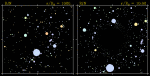
What would you see if you went right up to a black hole? Above are two computer generated images highlighting how strange things would look. On the left is a normal star field containing the constellation Orion. Notice the three stars of nearly equal brightness that make up Orion's Belt.
 Dusty Environs of Eta Carinae
10.10.2002
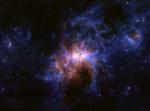
Eta Car is a massive star, but it's not as bright as it used to be. Now only easily visible in binoculars or a small telescope, Eta Carinae has a history of spectacular flaring and fading behavior.
 Hubble Floats Free
24.11.2002
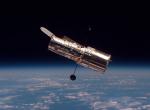
Why put observatories in space? Most telescopes are on the ground. On the ground, you can deploy a heavier telescope and fix it more easily. The trouble is that Earth-bound telescopes must look through the Earth's atmosphere.
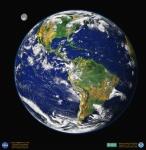 Big Blue Marble Earth
26.04.2003
This reconstructed digital portrait of our planet is reminiscent of the Apollo-era pictures of the "big blue marble" Earth from space. To create it, researchers at Goddard Space Flight Center's Laboratory for Atmospheres...
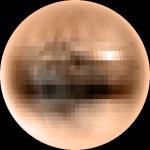 Pluto in True Color
3.09.2006
Pluto is mostly brown. The above picture captures the true colors of Pluto as well as the highest surface resolution so far recovered. Although no spacecraft has yet visited this distant world, the New Horizons spacecraft launched early this year is expected to reach Pluto in 2015.
|
January February March April May June July August September |
|||||||||||||||||||||||||||||||||||||||||||||||||