
|
You entered: telescope
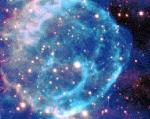 A Wolf-Rayet Star Blows Bubbles
3.01.1997
Wolf-Rayet stars can blow bubbles. These unusual stars are much hotter and more luminous than our Sun. All extremely massive stars will eventually evolve though a Wolf-Rayet phase. Approximately 200 Wolf-Rayet stars are known in our Milky Way Galaxy. Wolf-Rayet stars generate bubbles because they continually eject their outer atmosphere as a stellar wind.
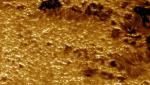 The Suns Surface in 3D
24.06.2003
How smooth is the Sun? The new Swedish 1-m Solar Telescope, deployed in the Canary Islands only last year, allows imaging of objects less than 100-km across on the Sun's surface. When pointed toward the Sun's edge, surface objects now begin to block each other, indicating true three-dimensional information.
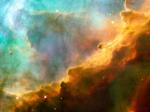 APOD: 2004 August 28- M17: A Hubble Close-Up
28.08.2004
Sculpted by stellar winds and radiation, these fantastic, undulating shapes lie within the stellar nursery known as M17, the Omega Nebula, some 5,500 light-years away in the nebula-rich constellation Sagittarius. The lumpy features...
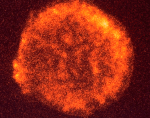 Tychos Supernova Remnant in X ray
7.03.1999
How often do stars explode? By looking at external galaxies, astronomers can guess that these events, known as a supernovae, should occur about once every 30 years in a typical spiral galaxy like our MilkyWay.
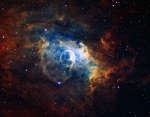 NGC 7635: The Bubble Nebula
11.10.2011
It's the bubble versus the cloud. NGC 7635, the Bubble Nebula, is being pushed out by the stellar wind of massive central star BD+602522. Next door, though, lives a giant molecular cloud, visible to the right. At this place in space, an irresistible force meets an immovable object in an interesting way.
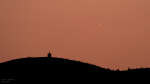 The Last Days of Venus as the Evening Star
5.10.2018
That's not a young crescent Moon poised above the hills along the western horizon at sunset. It's Venus in a crescent phase. About 54 million kilometers away and less than 20 percent illuminated, it was captured by telescope and camera on September 30 near Bacau, Romania.
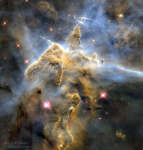 Mountains of Dust in the Carina Nebula
1.08.2022
It's stars versus dust in the Carina Nebula and the stars are winning. More precisely, the energetic light and winds from massive newly formed stars are evaporating and dispersing the dusty stellar nurseries in which they formed.
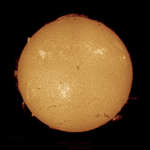 Perihelion Sun 2023
14.01.2023
Perihelion for 2023, Earth's closest approach to the Sun, was on January 4 at 16:17 UTC. That was less than 24 hours after this sharp image of the Sun's disk was recorded with telescope and H-alpha filter from Sidney, Australia, planet Earth.
 APOD: 2025 September 25 Б Saturn Opposite the Sun
25.09.2025
This year Saturn was at opposition on September 21, opposite the Sun in planet Earth's sky. At its closest to Earth, Saturn was also at its brightest of the year, rising as the Sun set and shining above the horizon all night long among the fainter stars of the constellation Pisces.
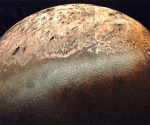 Triton: Neptune's Largest Moon
10.10.1996
Today marks the 150th anniversary of the discovery of Triton. On October 10 1846, William Lassell was observing the newly discovered planet Neptune. He was attempting to confirm his observation, made just the previous week, that Neptune had a ring. But this time he discovered that Neptune had a satellite as well.
|
January February March April May |
|||||||||||||||||||||||||||||||||||||||||||||||||